27 Arizona Backyard Ideas for Your Desert Oasis
27 Arizona Backyard Ideas for Your Desert Oasis
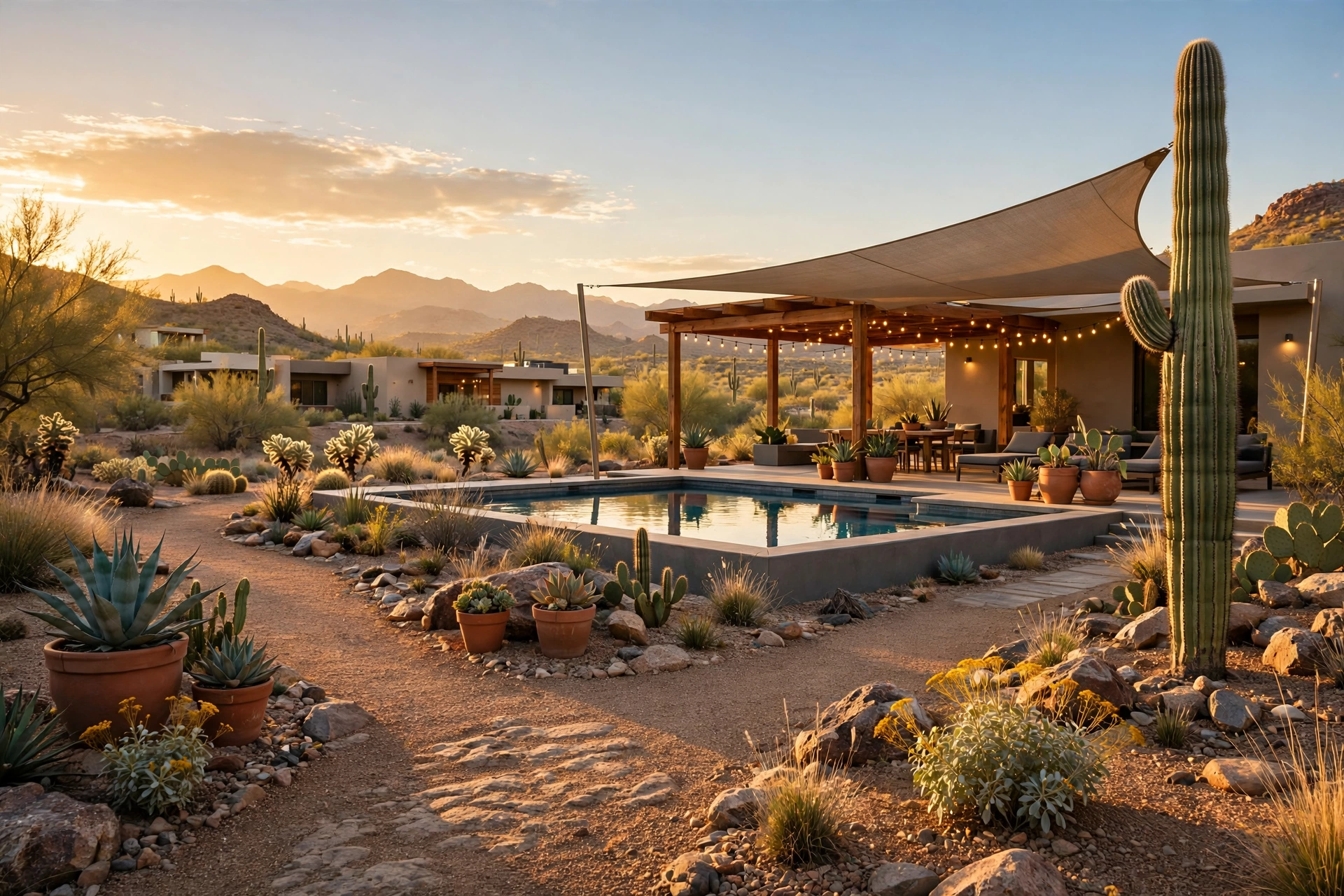
An Arizona backyard does not have to be a patch of gravel and a lonely cactus. With the right mix of shade, native plants, water-smart design, and a few well-chosen comforts, even the hottest Phoenix or Tucson yard can feel like a desert resort — cool in the shade, alive with color after the monsoon rains, and easy to care for all year. The trick is to work with the desert instead of fighting it: choose plants that already love the heat, build shade before you build anything else, and let stone, wood, and terracotta do the decorating. The 27 ideas in this guide cover the whole yard, from a low-water xeriscape garden and a saguaro focal point to a plunge pool, an outdoor kitchen, and a stargazing patio, so you can build your own desert oasis one project at a time.
1. Plant a Xeriscape Garden With Native Plants
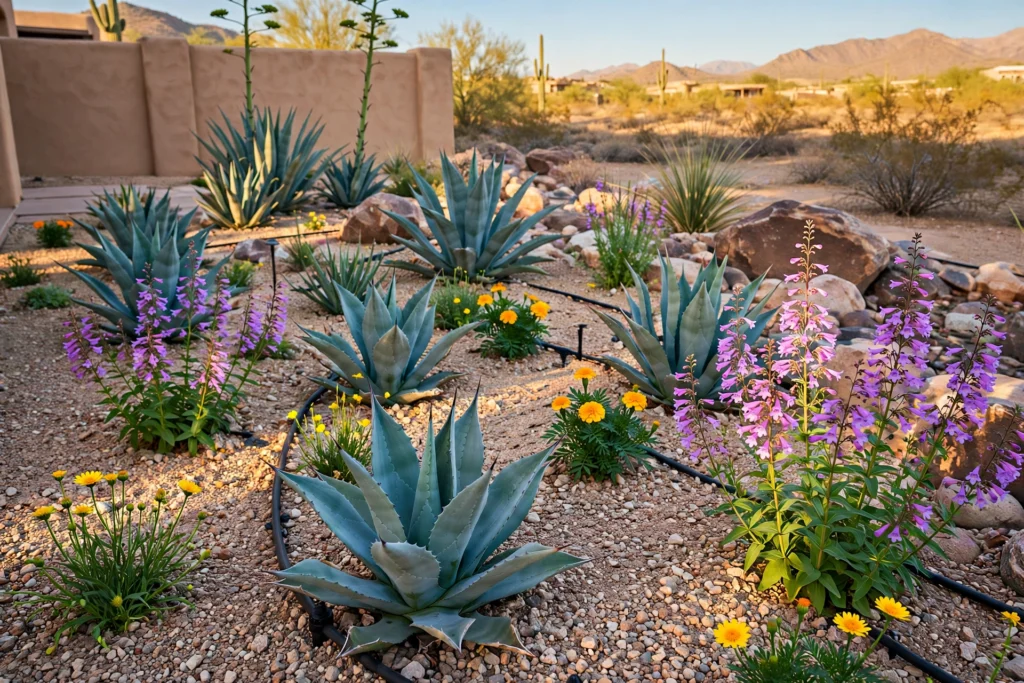
A xeriscape garden is the foundation of almost every great Arizona backyard, because it replaces thirsty lawn with plants that evolved for exactly this climate. Start with a backbone of native and desert-adapted plants — agave, prickly pear, desert marigold, penstemon, globe mallow, and red yucca — grouped by how much water they need, so a single drip line can serve each zone without waste. Mulch the beds with decomposed granite or small river rock instead of bark, which dries out and blows away in the desert wind, and leave breathing room between plants so each one can show off its shape.
The payoff is a garden that looks intentional in every season and asks almost nothing of you in return. Native plants bloom in waves — orange globe mallow in spring, purple penstemon in early summer, yellow desert marigold nearly all year — so the garden never looks empty, and hummingbirds and butterflies show up on their own. Water deeply but rarely, prune once or twice a year, and skip the fertilizer: desert plants grow tougher and prettier when they are not overfed.
2. Make a Saguaro and Cactus Sculpture Garden
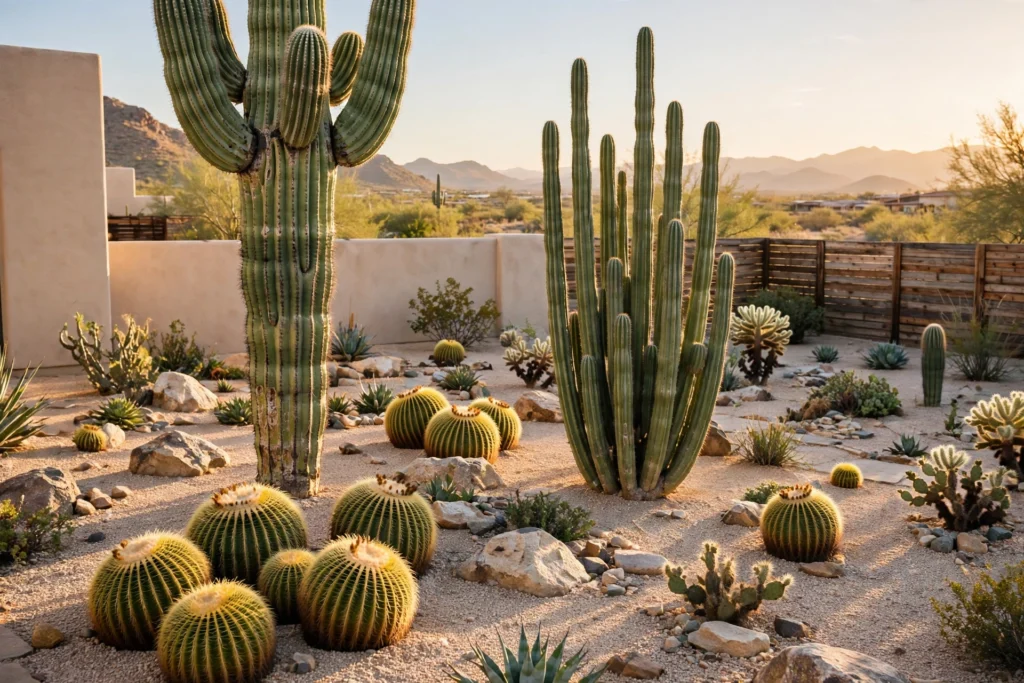
Few things say Arizona like a saguaro, and a small collection of sculptural cacti can carry a whole corner of the yard the way a fountain carries a courtyard. Plant one tall saguaro as the anchor — it grows slowly, so buy the largest specimen your budget allows — then layer in barrel cacti, blue agave, organ pipe, and Mexican fence post cactus at different heights so the bed reads like a living sculpture gallery. Set them in a bed of pale decomposed granite, which makes the green and blue-green forms pop, and edge the bed with a low row of desert stone.
Keep the planting simple and give each cactus room to grow, because a crowded cactus bed turns into a thorny tangle within a few years. A single uplight at the base of the saguaro turns the whole bed into a dramatic silhouette after dark, and a few smooth river rocks tucked between the plants finish the look without adding any maintenance. If you have kids or pets, place the spiniest specimens toward the back of the bed and keep the paths wide and clear.
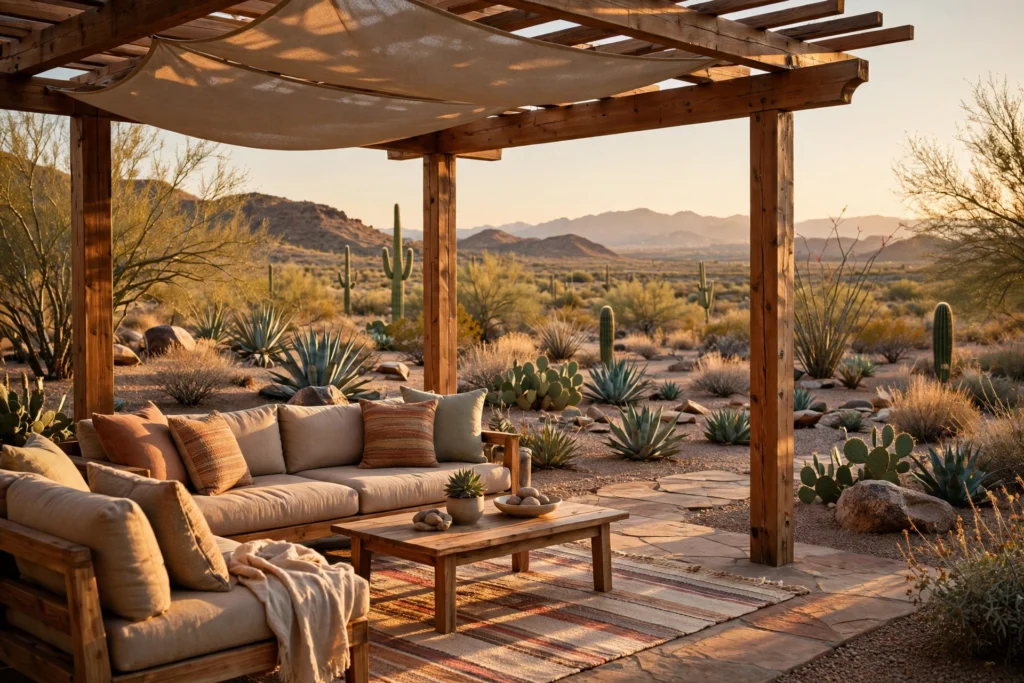
3. Build a Shaded Pergola Retreat
In Arizona, shade is not a luxury — it is the difference between a backyard you use and a backyard you avoid from May to September. A pergola over the patio is the fastest way to create it, and it gives the yard a defined outdoor room at the same time. Build it from cedar or redwood, which handle the dry heat better than pine, and size it generously: a pergola that only shades the table leaves the chairs in full sun by mid-afternoon. A retractable shade cloth or slatted roof with adjustable louvers lets you tune the light through the day.
Furnish the space underneath like a real room rather than a leftover patio. An outdoor rug in a faded terracotta pattern, a low sofa with washable cushions, and a ceiling fan rated for outdoor use turn the pergola into the coolest spot in the house during the hot months. Train a native vine such as queen’s wreath or cat’s claw over the beams for living shade that drops the temperature a few more degrees — and smells wonderful when it blooms.
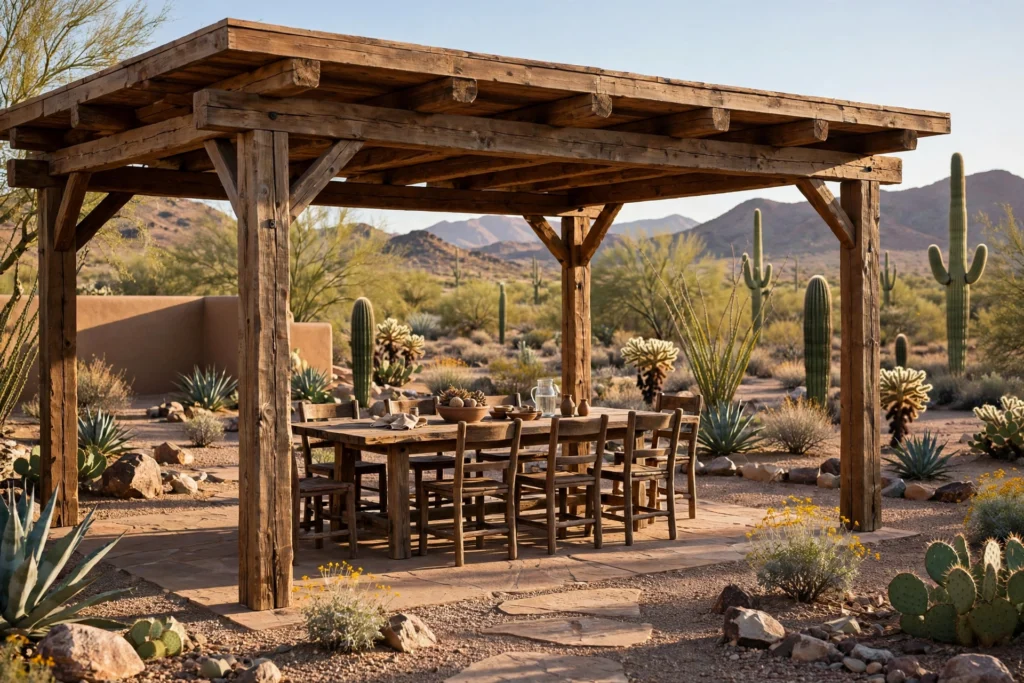
4. Add a Traditional Ramada for Deep Shade
A ramada is Arizona’s original shade structure — an open-sided, flat-roofed shelter on sturdy posts — and it shades far more deeply than a pergola because its solid roof blocks the sun completely. That makes it the best choice for the hottest part of the yard, especially over a dining table or an outdoor kitchen where you want real relief at noon. Build it with heavy timber posts and a metal or wood roof with a slight pitch, and leave the sides open so the breeze can pass through and carry the heat away.
Style the ramada like a desert lodge rather than a carport. Hang a couple of woven pendant lights from the beams, set a long wooden table with benches underneath, and add a built-in bench along one side for extra seating during big family gatherings. Because the roof is solid, a ramada also shelters you from the sudden monsoon downpours of July and August — the one time of year when a pergola’s open slats let the rain straight through.
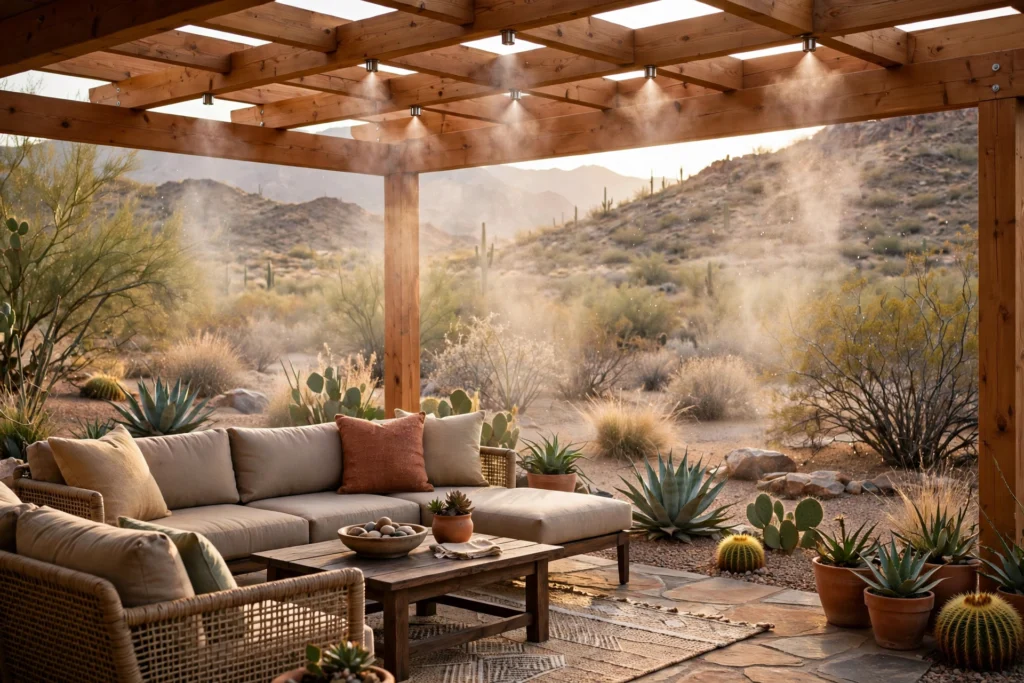
5. Cool the Patio With a Misting System
A misting system is the closest thing to air conditioning for an Arizona patio, and it can drop the temperature in a shaded seating area by twenty degrees or more on a dry afternoon. The system is simple: a pump pushes water through fine nozzles mounted along the pergola beams or patio edge, and the tiny droplets evaporate before they ever reach the ground, pulling heat out of the air. It works best in Arizona’s low humidity, which is exactly why it struggles in muggy climates and shines here.
Mount the nozzles high and aim them slightly outward so the mist drifts down over the seating area instead of spraying anyone directly, and put the system on a timer or a remote so it runs only when you are outside. Use filtered water to keep the nozzles from clogging with mineral buildup, and drain the lines before winter if your area gets a hard freeze. Pair the misters with a ceiling fan and you get a patio that stays comfortable well into June.
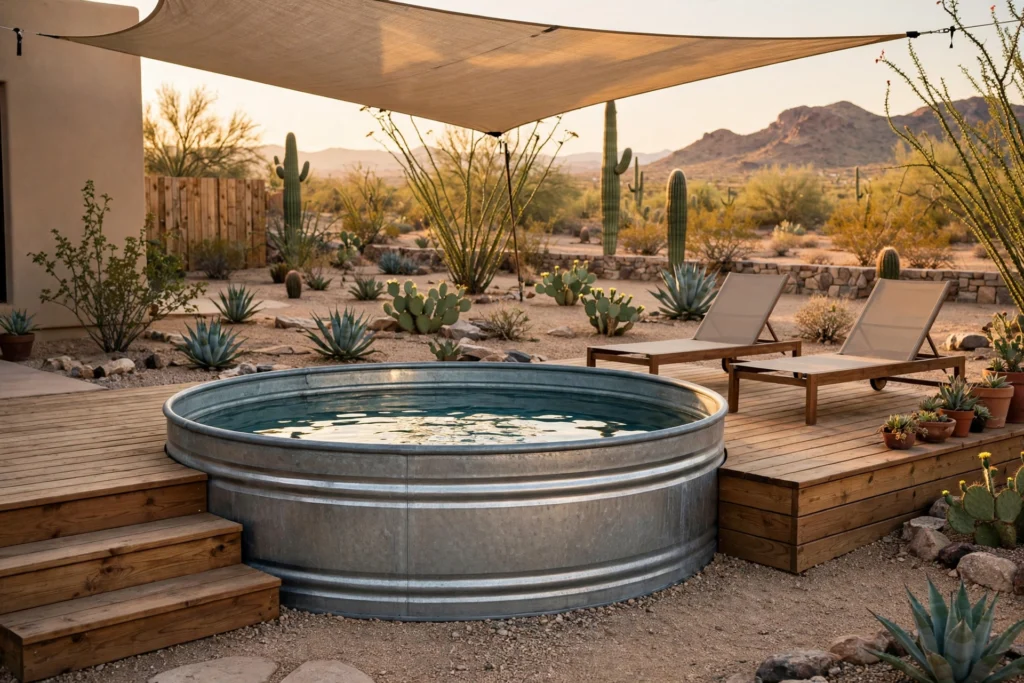
6. Sink a Stock Tank Plunge Pool
A full in-ground pool is a big commitment in the desert, but a stock tank plunge pool gives you the same relief for a fraction of the cost and the water. A galvanized steel tank, eight feet across and two feet deep, holds enough water to cool off completely, and it fits in a side yard or a small patio corner where a real pool never would. Set it on a level pad of decomposed granite or pavers, add a simple pump and filter, and surround it with a low wooden deck so it reads as a designed feature rather than a farm supply.
Dress the tank up to match the rest of the yard: paint the outside a soft desert sage or terracotta, wrap it in cedar slats, or build a low stone wall around the base. A shade sail overhead keeps the water from turning into bathwater by August, and a couple of lounge chairs plus a side table turn the corner into a tiny resort. In winter the tank doubles as a cold plunge, which is one more reason the desert version beats a regular pool.
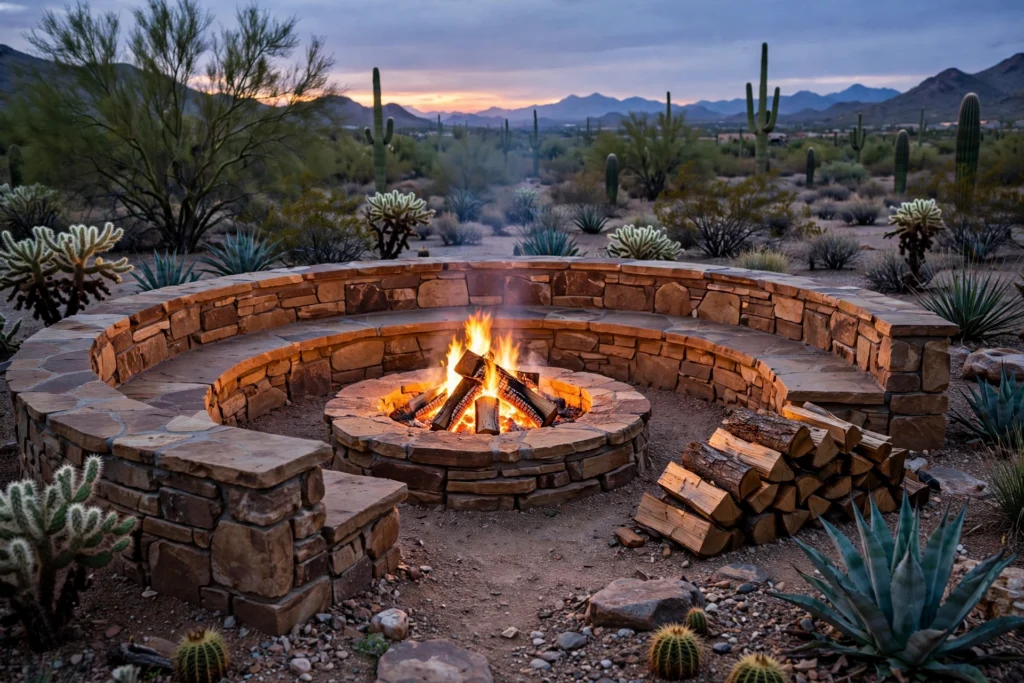
7. Gather Around a Fire Pit With Desert Stone Seating
Arizona evenings are the payoff for Arizona afternoons, and a fire pit is how you enjoy them. Build the pit from local stone — sandstone, flagstone, or river rock — in a low, wide bowl shape, and surround it with built-in curved seating walls topped with smooth capstones so nobody has to drag chairs across the gravel. The stone holds the day’s warmth and releases it slowly after sunset, which keeps the seating area comfortable even on a cool January night.
Place the fire pit where it catches the evening breeze but sits clear of overhanging trees and the house, and keep a stack of mesquite firewood nearby — it burns hot, smells wonderful, and is the classic Arizona firewood. Add a few low-voltage lights in the surrounding planting beds so the path to the pit is easy to find after dark, and keep a simple metal spark screen on hand for windy nights. It becomes the default gathering spot from October through April.
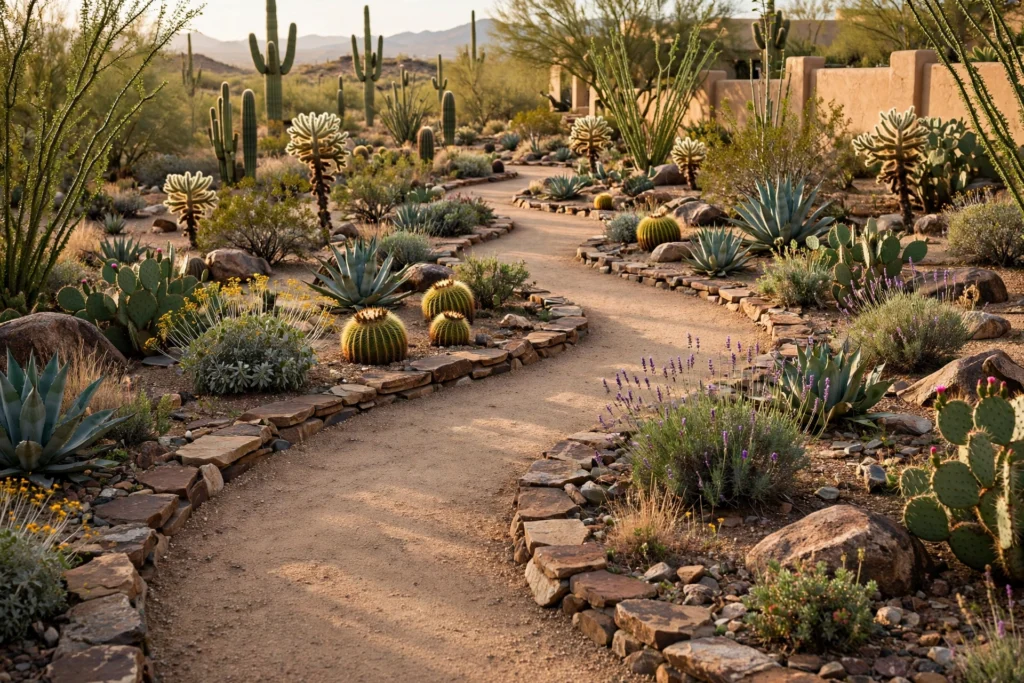
8. Lay Decomposed Granite Pathways
Decomposed granite is the desert’s answer to a lawn path: it looks natural, drains instantly, and never needs mowing, watering, or weeding the way turf does. Lay it as winding paths between the planting beds, edged with steel or stone so it stays put, and compact it in thin layers with a light watering between each one so it sets into a firm, walkable surface. Choose a warm tan or dusty rose tone that matches your house and the surrounding desert, and use a slightly darker granite in the planting beds for contrast.
The real advantage shows up in the rainy season, when the paths stay firm and mud-free while a dirt trail would turn to soup. Keep the paths wide enough for two people to walk side by side — about four feet — and add a flat stepping stone or two at the corners where foot traffic is heaviest. A quick rake once a month keeps them looking fresh, and a top-up of granite every year or two replaces whatever the wind and the monsoon carried away.
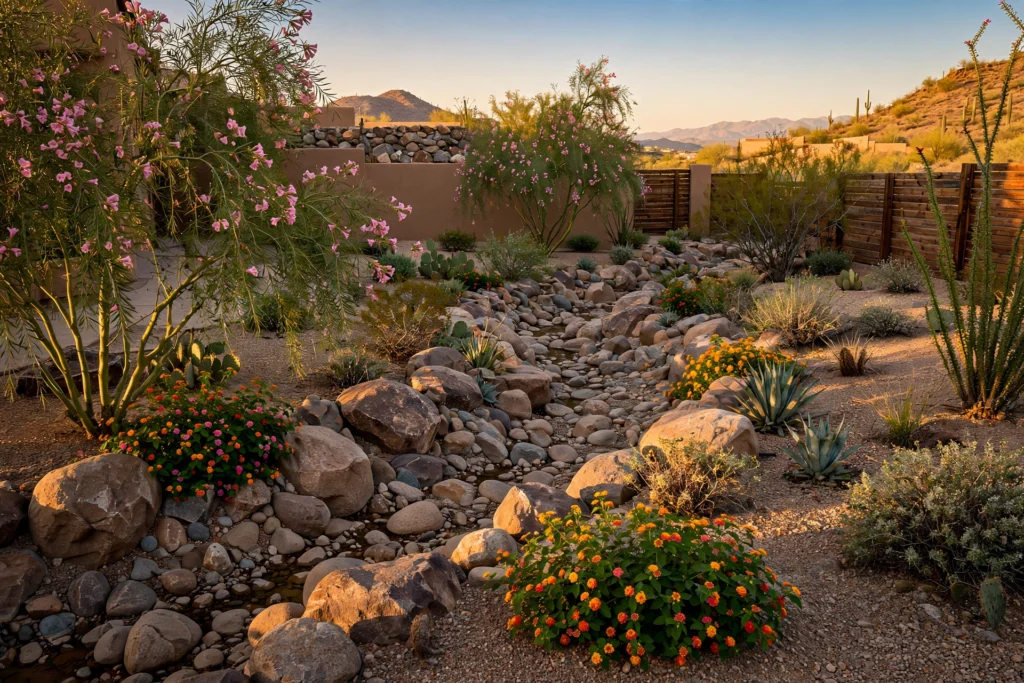
9. Carve a Dry Creek Bed Through the Yard
A dry creek bed turns a drainage problem into the prettiest feature in the yard. Arizona’s monsoon rains arrive fast and hard, and a shallow, meandering swale lined with river rock gives that water somewhere useful to go instead of pooling against the house. Dig the channel six to eight inches deep with gently sloping sides, line it with landscape fabric, and fill it with a mix of large boulders at the edges and smooth river rock in the middle, arranged so the stones look like they were left there by real water.
Plant the banks with the plants that love a little extra moisture — desert willow, yellow bells, and lantana do well here — and let a few grasses spill over the edges so the bed looks natural rather than engineered. A small wooden footbridge over the widest part turns the creek into a garden moment instead of a ditch, and a solar light tucked among the boulders makes it glow after dark. It is practical drainage and landscape art in one project.
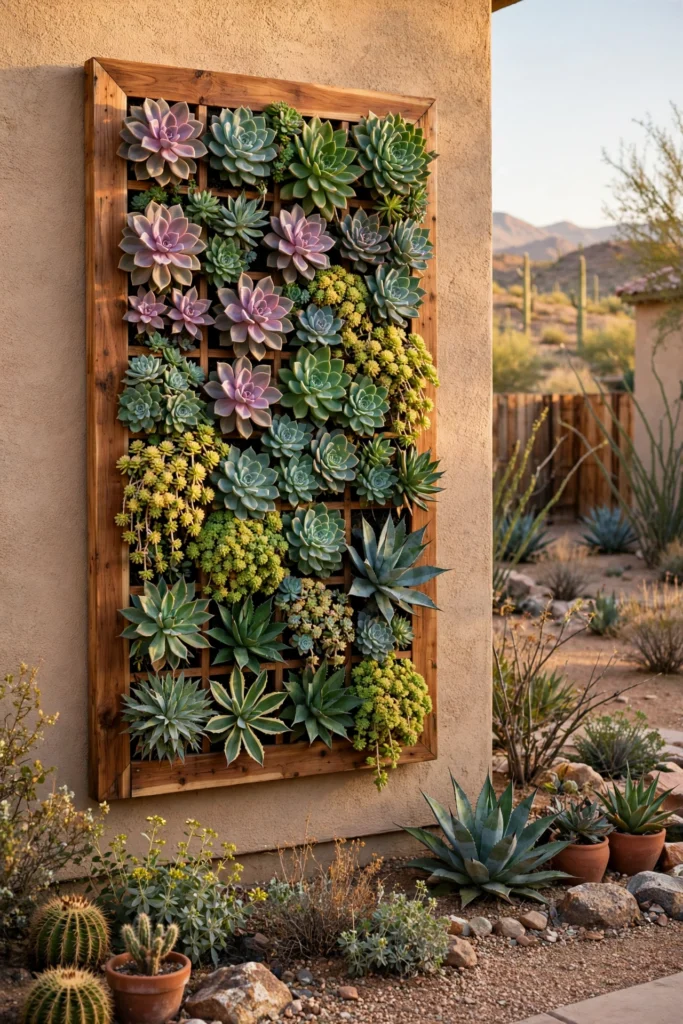
10. Grow a Succulent Wall on a Blank Stucco Wall
A blank stucco wall in an Arizona backyard soaks up heat all day and gives nothing back, but a vertical succulent wall turns it into living art. Mount a simple frame of cedar boxes or a pocket planter system, fill it with a fast-draining cactus mix, and plant a pattern of echeveria, sedum, string of pearls, and small agaves in contrasting colors — dusty blue, lime green, burgundy — so the wall reads like a quilt from across the yard. Drip irrigation along the top row keeps every pocket watered without waste.
Start with the wall that gets morning sun and afternoon shade, because even succulents can scorch on a west-facing wall in July. Plant the pockets tightly so the wall fills in within a season, and tuck a few trailing varieties along the bottom edge so they spill over the frame. The wall needs almost no care beyond a monthly check of the irrigation and a quick trim of anything that outgrows its pocket — and it stays green and sculptural all year, even in the middle of summer.
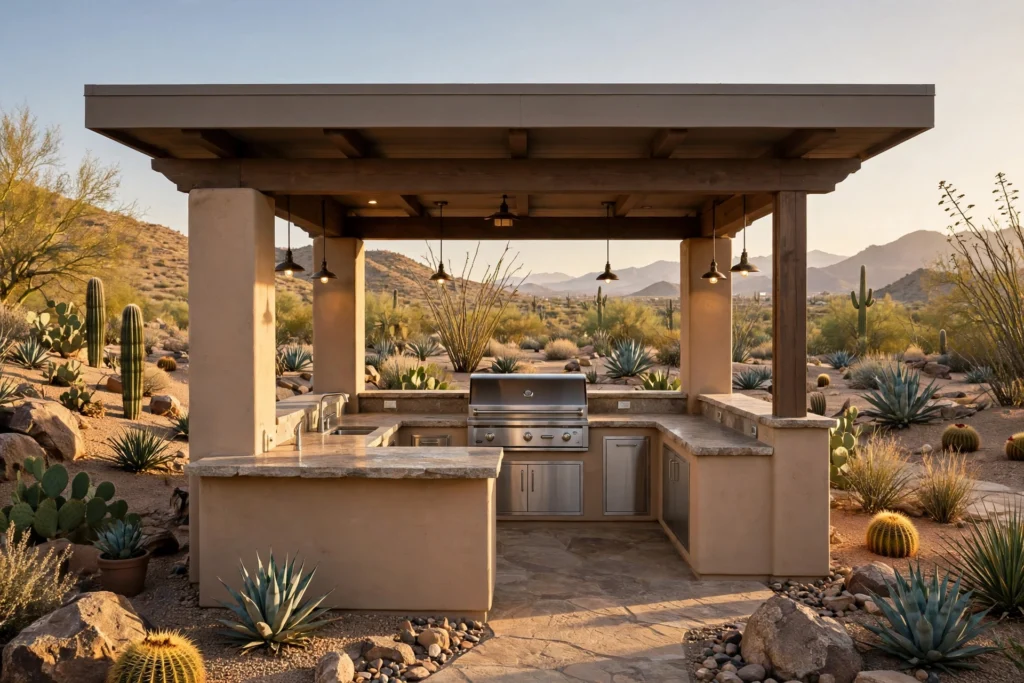
11. Build an Outdoor Kitchen With a Built-In Grill
An outdoor kitchen turns an Arizona backyard from a place you look at into a place you live in, and it earns its keep from March through November. Start with the essentials — a built-in gas grill, a stone or concrete counter for prep, and a small fridge for drinks — then add a sink and a pizza oven if the budget stretches. Build the structure from stucco and stone to match the house, and put the whole kitchen under a ramada or a solid pergola roof so the cook is not standing in the midday sun.
Keep the layout simple and the materials tough: stainless steel appliances, sealed stone counters, and storage that seals tight against dust storms. A bar-height counter on the outside of the kitchen gives guests a place to sit with a drink while dinner cooks, and a few pendant lights overhead mean the kitchen works just as well for a December evening barbecue as a July lunch. It is the single upgrade most likely to change how often you actually use the yard.
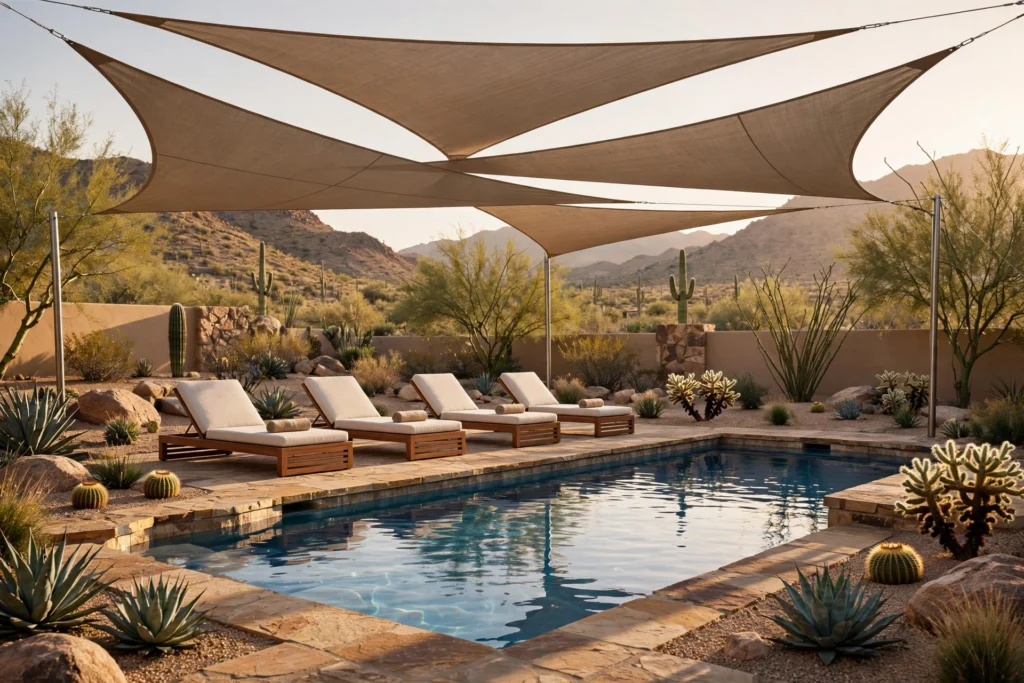
12. Shade the Pool With a Sail and Lounge Area
A pool without shade is a pool you can only use at dawn and dusk, so a shade sail over the lounge area is one of the best investments an Arizona pool owner can make. Stretch one or two triangular sails from the house to tall posts at the pool’s edge, overlapping them slightly so the shade moves across the deck as the sun moves. Choose a UV-rated fabric in a warm sand or terracotta tone that filters the light without turning the whole area dark, and angle the sails so rain runs off instead of pooling.
Underneath, keep the furniture low and lounge-ready: a pair of chaises with outdoor cushions, a side table for cold drinks, and an outdoor rug that can handle splashes. A small storage bench holds pool toys and towels, and a misting line along the sail’s edge cools the whole area on the hottest afternoons. When winter comes, the sails unclip in minutes and store in a bag, leaving the pool open to the low winter sun.
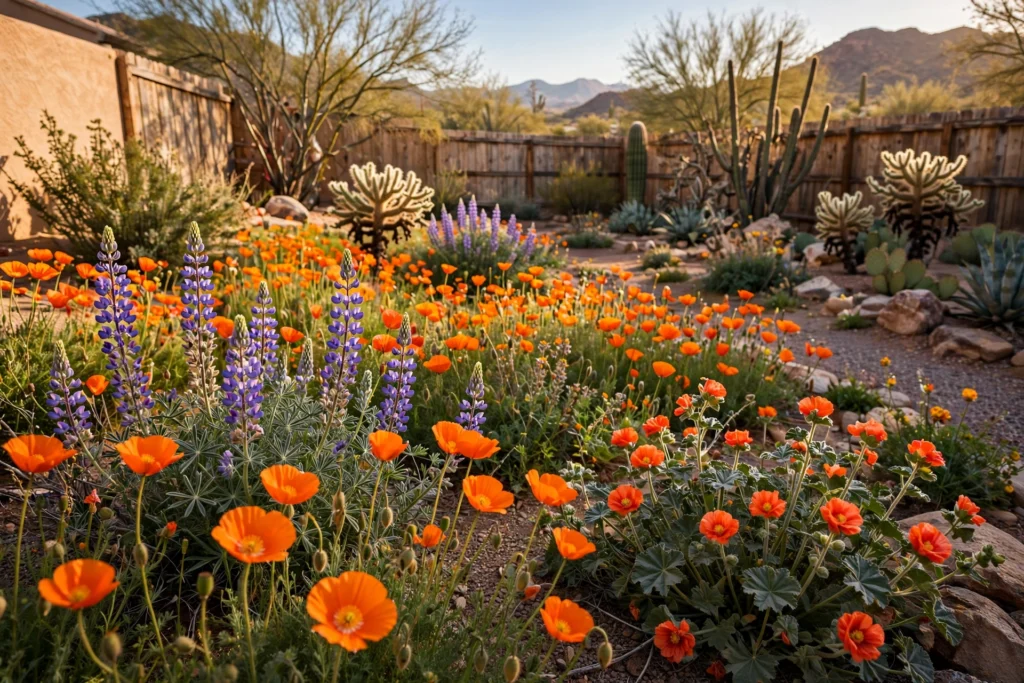
13. Sow a Desert Wildflower Meadow
For a few glorious weeks each spring, the Arizona desert erupts in wildflowers — and you can grow that same show in your own yard with a packet of seed and a little patience. Sow a native mix of Mexican gold poppy, desert lupine, globe mallow, and penstemon in October, rake the seed lightly into bare soil, and water just enough to keep the ground damp until the seedlings establish. Then step back and let the winter rains do the rest, because desert wildflowers are programmed to wait for exactly the right conditions.
The trick is to accept that a wildflower meadow is seasonal, not permanent. It will blaze in March and April, set seed in May, and go brown by June — and that is fine, because the seeds it drops will come back next year bigger than before. Mow the meadow once after it dries out, leave the clippings in place so the seed falls, and plant a few agaves and grasses at the edges so the bed still looks intentional in summer. It is the cheapest big-color project in this whole guide.
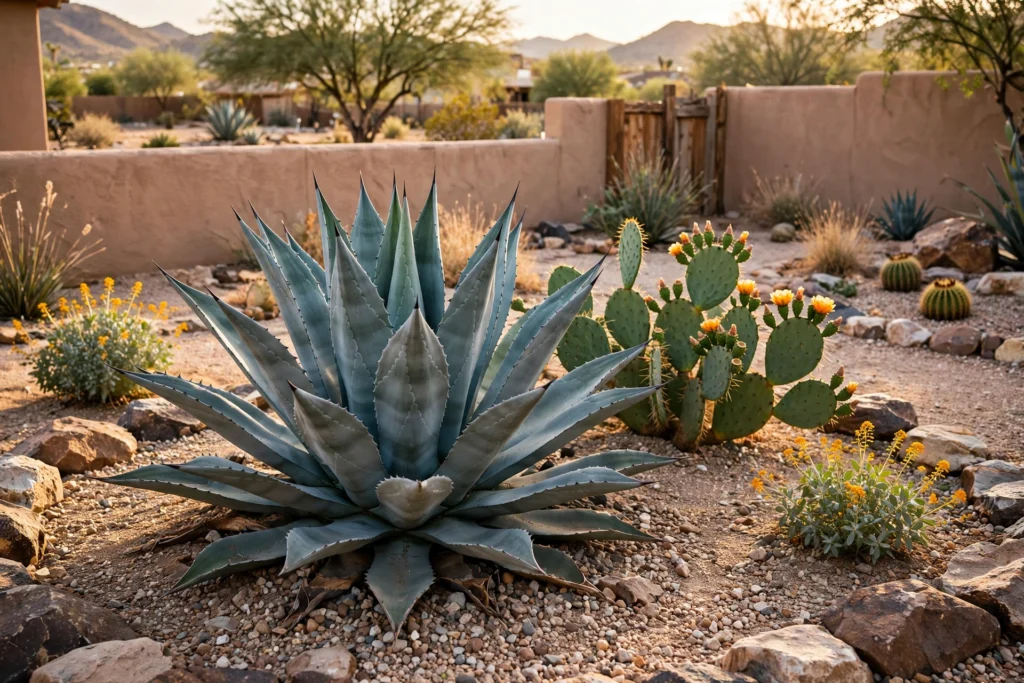
14. Anchor Beds With Agave and Prickly Pear
Blue agave and prickly pear are the workhorses of Arizona landscaping: they look architectural all year, survive on almost no water, and cost almost nothing to maintain once established. Use a big blue agave as the anchor of each bed — its symmetrical rosette is so sculptural it needs no companions — then fill around it with prickly pear pads, which add a softer, rounder shape and a flush of yellow flowers in spring followed by red fruit. Plant them in raised mounds of gravelly soil so water drains away from their crowns, which is the one thing they cannot tolerate.
Give agaves room, because a mature blue agave can spread five feet wide, and site them where nobody will brush against their sharp leaf tips — along a wall or at the back of a bed rather than beside a path. Prickly pear pads root easily from a single cutting, so you can fill a whole bed from one nursery plant in a season or two. Together they give a bed structure, color, and a distinctly desert character that no imported shrub can match.
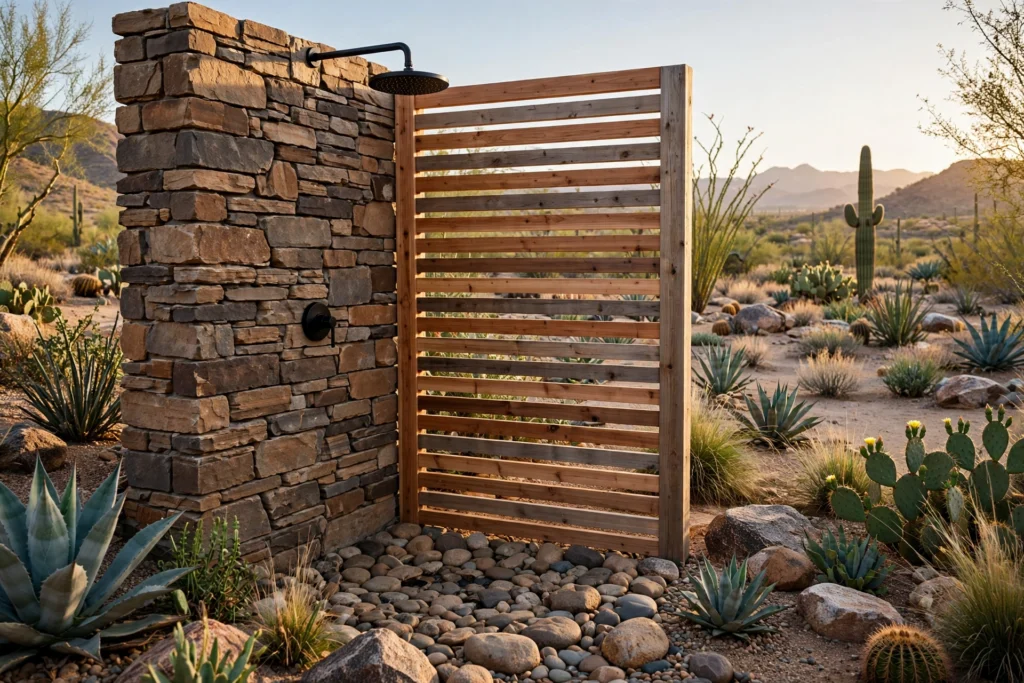
15. Rinse Off in an Outdoor Shower
An outdoor shower is one of those small luxuries that makes a desert backyard feel like a resort, and it is surprisingly practical too. After a swim, a dusty gardening session, or a hike, you can rinse off outside instead of tracking sand and sunscreen through the house. Build it against a garden wall or a freestanding screen of cedar slats, run a simple hot and cold line from the house, and pave the floor with river rock or flagstone so the water drains away fast.
Privacy is the only real design problem, and it is easy to solve: a six-foot slatted screen blocks the view while letting the breeze through, and a tall agave or ocotillo planted beside the screen adds a living layer. Hang a teak bench and a hook for towels, add a rainfall showerhead, and plant a fragrant desert lavender nearby so the whole corner smells as good as it looks. It is a small project with an outsized payoff on a hot afternoon.
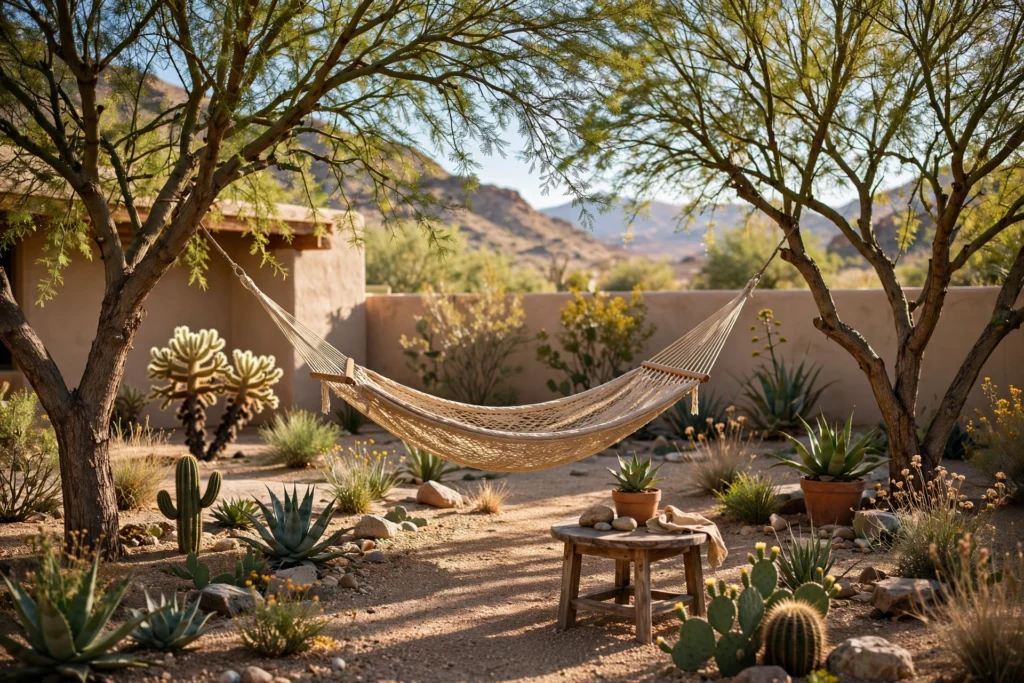
16. Hang a Hammock Between Two Mesquite Trees
Some of the best Arizona backyard ideas cost almost nothing, and a hammock between two mesquite trees is the proof. Mesquites grow fast, spread wide, and cast the dappled shade that makes a summer afternoon bearable, and their strong, low branches are made for hanging things from. Pick two trees about twelve to fifteen feet apart, hang the hammock with wide tree straps rather than screws so the bark stays healthy, and test the height so the hammock sags to about eighteen inches off the ground when you are lying in it.
Keep the spot simple: a small side table for a book and a cold drink, a patch of soft decomposed granite underneath, and maybe a string of solar lights in the branches for the evening. The hammock becomes the default nap spot from October through May, and in summer it is the best seat in the yard at eight in the morning and again after sunset. If your mesquites are still young, a sturdy hammock stand works just as well until the trees catch up.
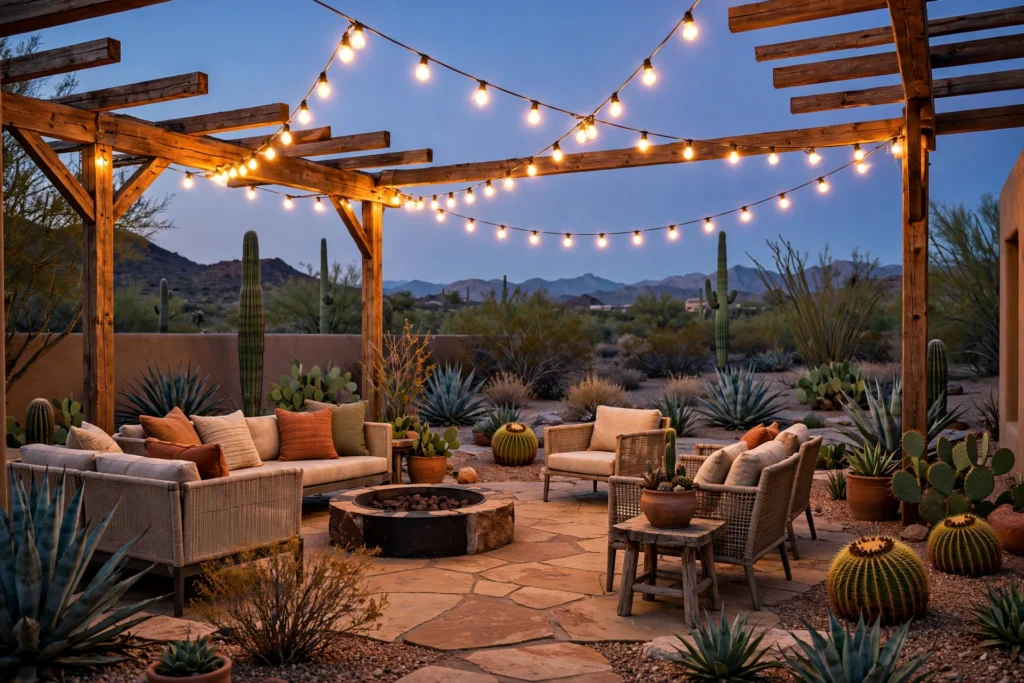
17. String Warm Lights Over the Patio
String lights are the fastest way to make an Arizona patio feel magical after dark, and they cost less than almost any other project in this guide. Run commercial-grade café lights in a zigzag or a loose catenary curve from the house to the pergola posts or a pair of tall poles, keeping the strands high enough to walk under and low enough that the bulbs still glow warmly over the table. Choose warm white bulbs — the cool white ones make a desert patio look like a parking lot — and put them on a dimmer or a timer so they come on at dusk on their own.
The lights do more than decorate: they extend the usable hours of the yard by two or three every evening, which matters in a climate where the best hours are the ones after the sun goes down. Pair them with a few solar path lights along the garden beds and a couple of lanterns on the table, and the whole yard glows without a single harsh floodlight. It is a one-afternoon project that changes how the backyard feels every single night.
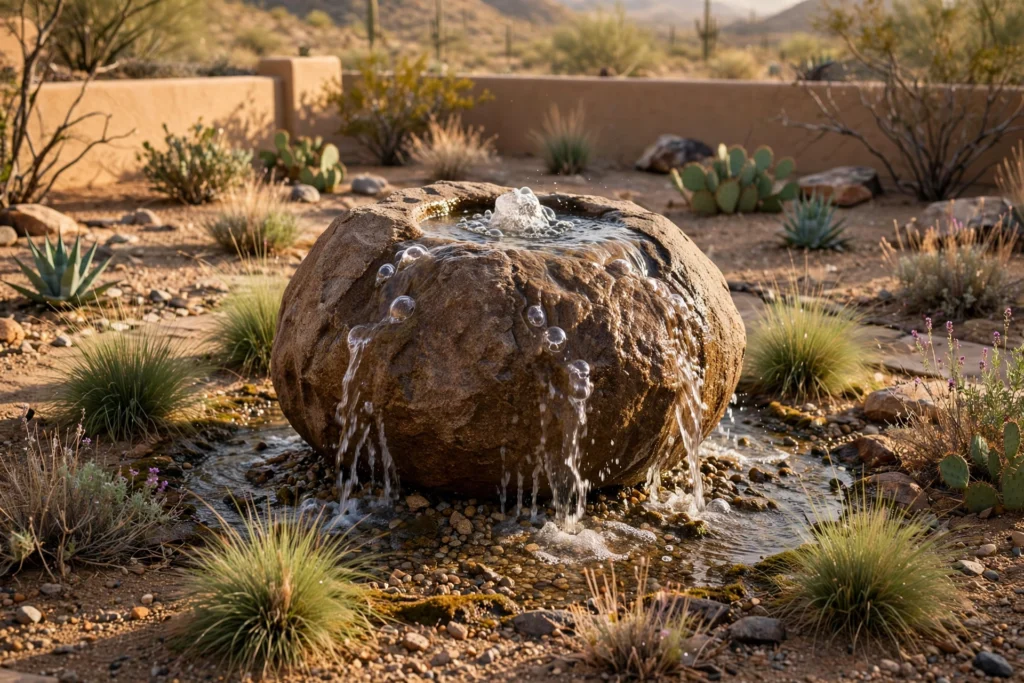
18. Add a Bubbling Rock Water Feature
The sound of moving water changes how a desert backyard feels, and a bubbling rock fountain delivers it without the water use of a pond. The design is simple: a pump in a hidden underground reservoir pushes water up through a drilled boulder, where it bubbles over the top and disappears back into the gravel bed below. Because the water recirculates and the reservoir is covered, evaporation stays low and mosquitoes never get a chance to breed.
Site the fountain where you will actually hear it — beside the patio seating or just outside a bedroom window — and surround it with a few smaller boulders and a planting of desert grasses so it looks like a natural spring rather than a garden-center kit. A solar-powered pump works well in Arizona’s sunshine and skips the need for an outdoor outlet, though a plug-in pump gives a stronger flow. Either way, it is the sound of an oasis, and it makes the whole yard feel ten degrees cooler.
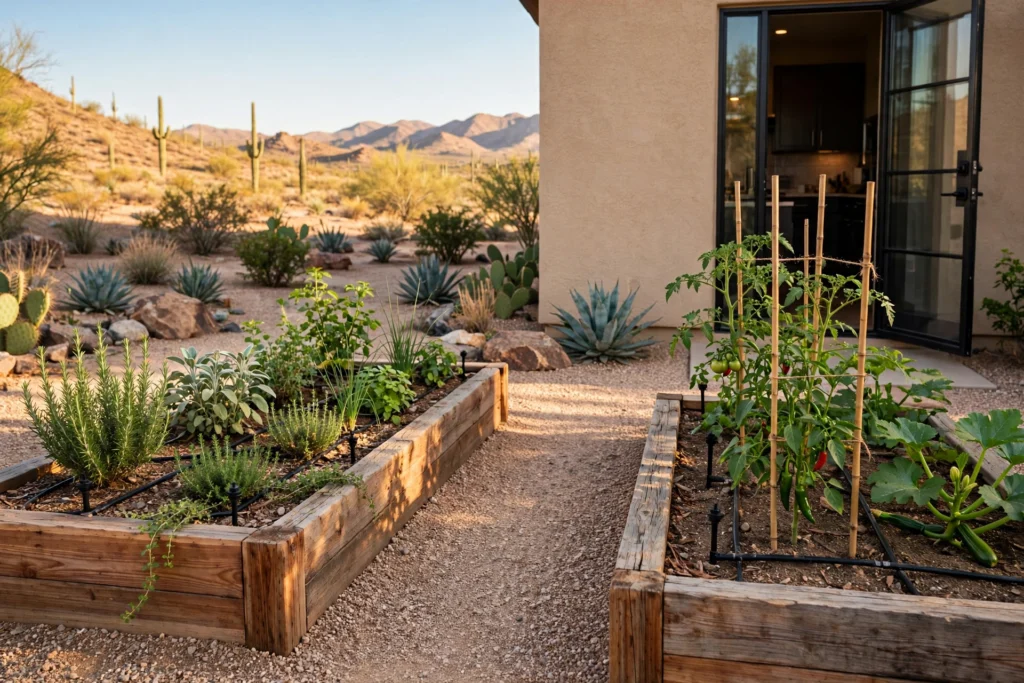
19. Grow Desert Herbs in Raised Beds
Arizona’s native soil is alkaline, rocky, and low in organic matter, which is why raised beds are the smart way to grow anything edible. Build the beds from cedar or stone, eighteen inches deep, fill them with a mix of compost and quality garden soil, and plant what actually thrives in the desert heat: rosemary, oregano, basil, and mint in the herb bed, and chiles, tomatoes, squash, and okra in the vegetable bed during the warm season. A drip line on a timer keeps the watering consistent without drowning the plants.
Time the planting to the desert’s two growing seasons — a cool season from October to March for lettuce, peas, and carrots, and a warm season from March to June for the heat lovers — and shade the beds with a simple cloth cover in July and August when even the toughest plants struggle. The beds sit close to the kitchen door so harvesting is a thirty-second walk, and a few marigolds planted at the corners pull in pollinators while keeping pests down. Fresh herbs in a desert garden are a small daily luxury.
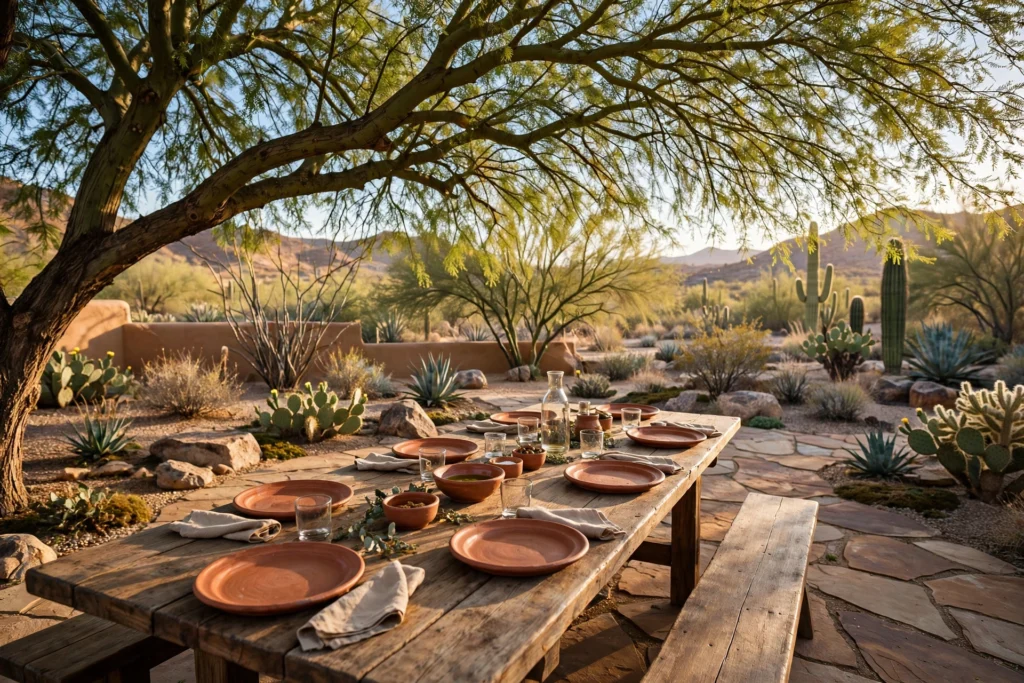
20. Dine Under a Mesquite Canopy
A mature mesquite tree is the best dining room an Arizona backyard can have: its feathery canopy filters the sun into moving shade, its branches stay cool to the touch, and it drops the temperature underneath by several degrees. Set a long wooden dining table directly under the canopy, with benches or mismatched chairs that can be pulled in and out as the guest list changes, and pave the area with flagstone or decomposed granite so the ground stays level and dust-free.
Keep the table setting simple and desert-appropriate: a linen runner, terracotta plates, a pitcher of iced tea, and a few lanterns for when dinner runs past sunset. Prune the mesquite once a year to lift the canopy high enough to walk under comfortably and to keep dead wood out of the dining area. It is the most-used outdoor dining spot in the yard from October through May, and the one your guests will remember.
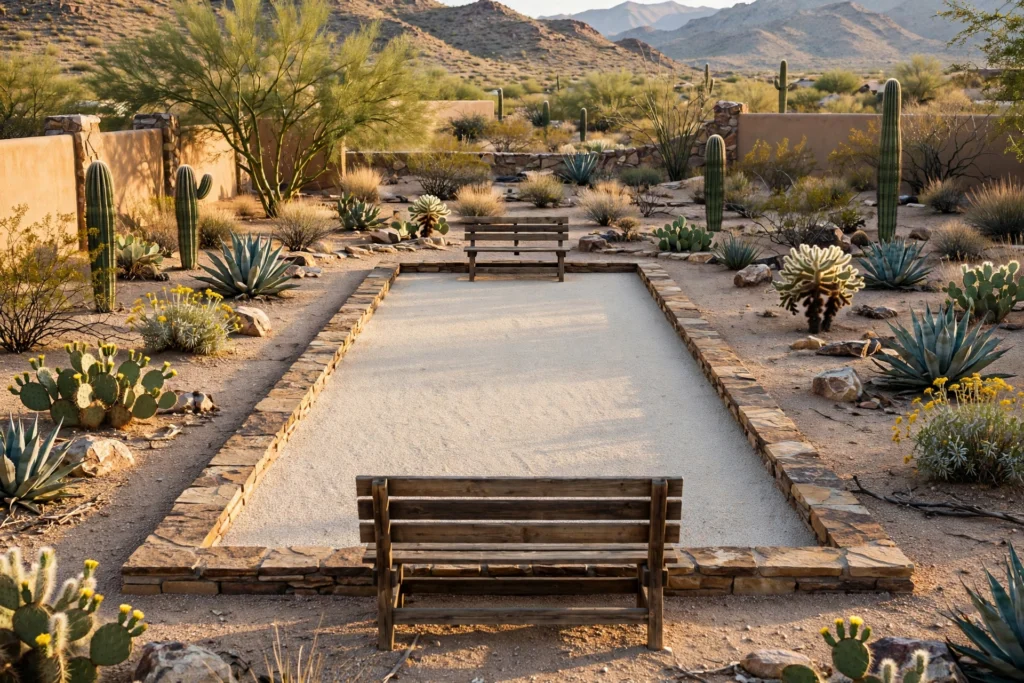
21. Level a Bocce Court on Gravel
A bocce court is the perfect desert lawn game: it needs no water, no mowing, and it gives the backyard a reason for everyone to gather. Level a strip about twelve feet wide and forty feet long, edge it with low stone or timber, and fill it with finely crushed granite or oyster shell, raked smooth and lightly compacted so the balls roll true. A string line down the center and a couple of low wooden benches at each end finish the court, and a shade sail overhead keeps the game going through the afternoon.
The court doubles as a design feature even when nobody is playing: its clean geometry and pale gravel contrast beautifully with the darker planting beds around it, and it reads as an intentional piece of landscaping rather than a leftover strip. Keep a wooden box of bocce balls by the back door so the game starts in under a minute, and add a small scoreboard on a post for family tournaments. It is low maintenance, high fun, and it works on ground that would never grow grass anyway.
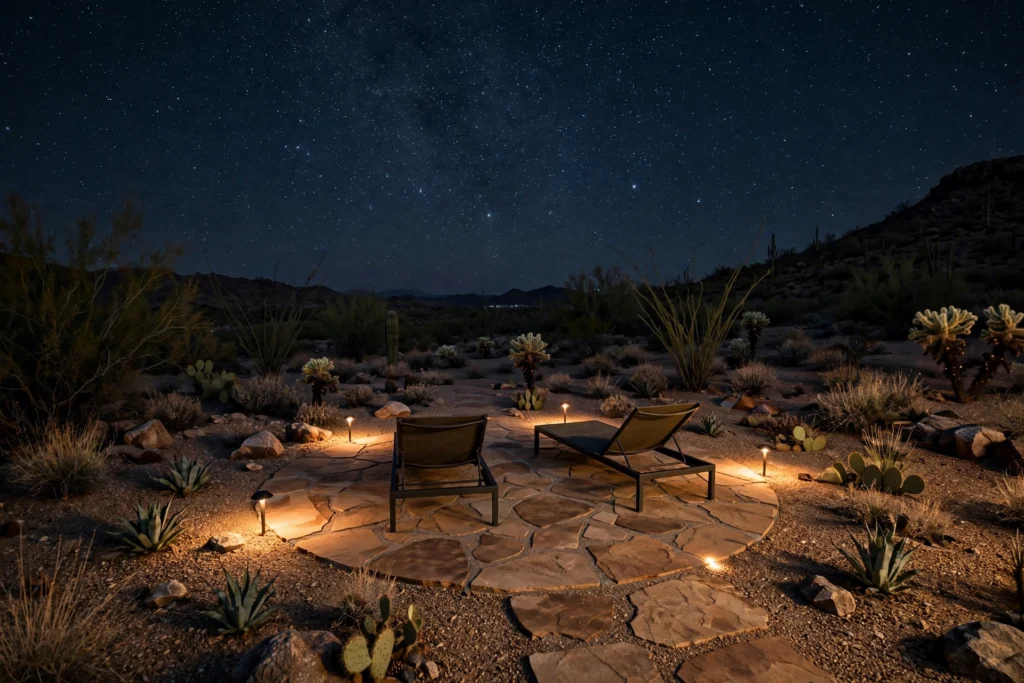
22. Build a Stargazing Patio
Arizona has some of the darkest skies in the country once you step away from the city glow, and a stargazing patio lets you enjoy them from your own backyard. Pick the darkest corner of the yard, pave a small circular patio in flagstone, and furnish it with two low lounge chairs or a daybed that reclines flat. The key is lighting: use only tiny, warm, downward-facing lights along the path, and skip the bright floodlights entirely, because it takes twenty minutes for your eyes to fully adjust to the dark.
Add a small fire bowl at the edge of the patio for warmth and a low table for a telescope or a star chart, and plant low desert grasses around the edge so nothing blocks the horizon. On a clear winter night, the Milky Way is bright enough to cast a shadow — and the patio becomes the place you end every evening, from the first monsoon storm watch in July to the meteor showers of August. It costs almost nothing and delivers the best show in the desert.
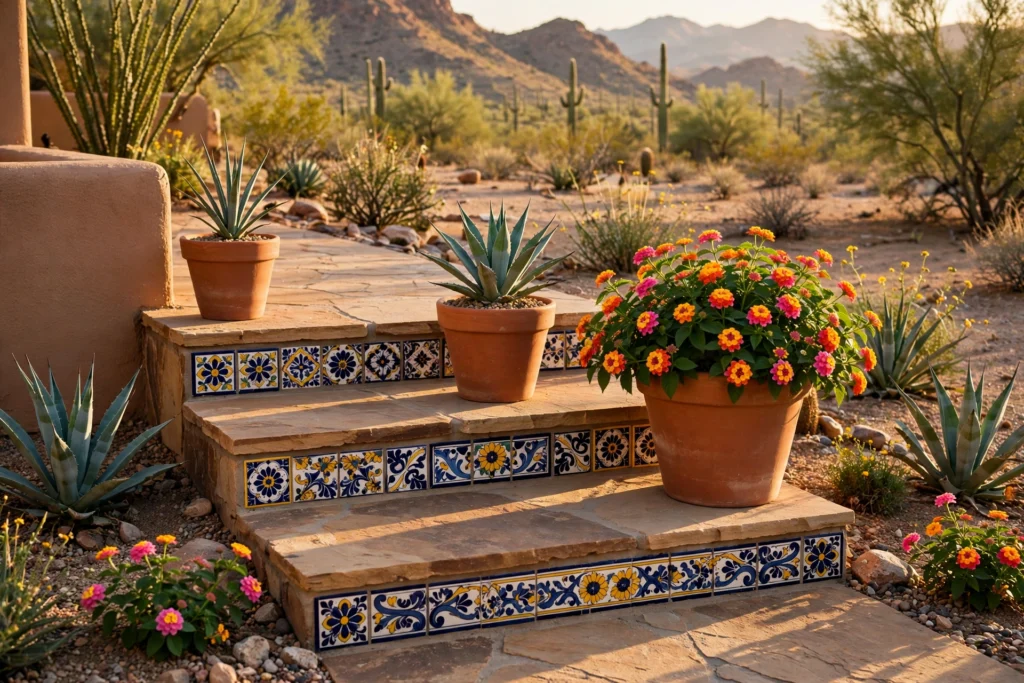
23. Accent With Terracotta and Talavera Tile
Terracotta pots and Talavera tiles are the color story of the Southwest, and a few well-placed accents can warm up a whole backyard without a single new plant. Cluster terracotta pots in three sizes by the front door or the patio steps, plant them with agave, lantana, and trailing rosemary, and let the clay weather naturally — the patina only gets better. Then carry the color into the hardscaping: a row of hand-painted Talavera tiles as a riser on the patio steps, a tiled inset in the outdoor kitchen backsplash, or a tiled border around a fountain.
The trick is restraint. A little Talavera goes a long way, so use it as jewelry — a single bold tile pattern repeated in one or two places — rather than tiling every surface in sight. Mix the bright blues, yellows, and greens of the tiles with the warm orange of the terracotta and the pale tones of the gravel, and the yard reads as intentional and collected rather than themed. It is the easiest way to give a new desert garden a sense of history.
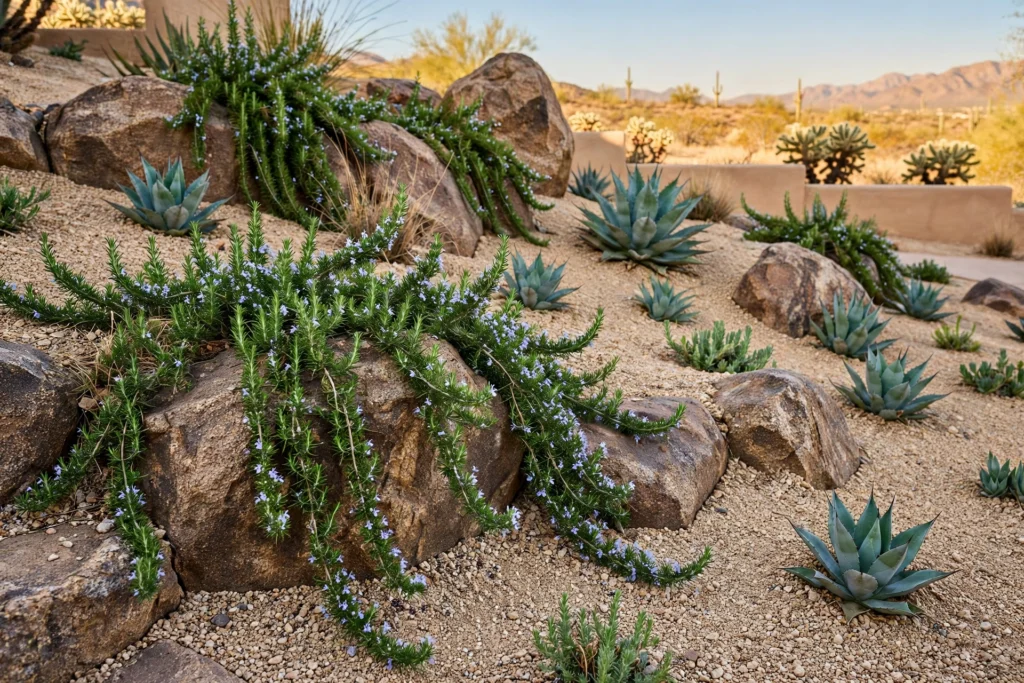
24. Sculpt a Boulder and Gravel Rock Garden
A rock garden is the desert’s version of a flower border: instead of color from blooms, it gets drama from form, texture, and the way the light moves across stone. Start with three to five large boulders in different sizes, set them at angles so they look half-buried rather than placed, then fill around them with a mix of gravel sizes — fine decomposed granite as the base, medium river rock in the swales, and a few smooth stones as accents. Tuck in low plants that hug the ground — blue fescue, trailing rosemary, and small agaves — so the garden looks alive rather than bare.
The beauty of a rock garden is that it asks almost nothing of you after the first season. No watering beyond what the plants need, no mowing, no pruning — just a quick rake of the gravel and a pull of the occasional weed after the monsoon. Site it where you will see it from inside the house, because a well-built rock garden is at its best in the low light of morning and evening, when the long shadows turn the boulders into sculpture.
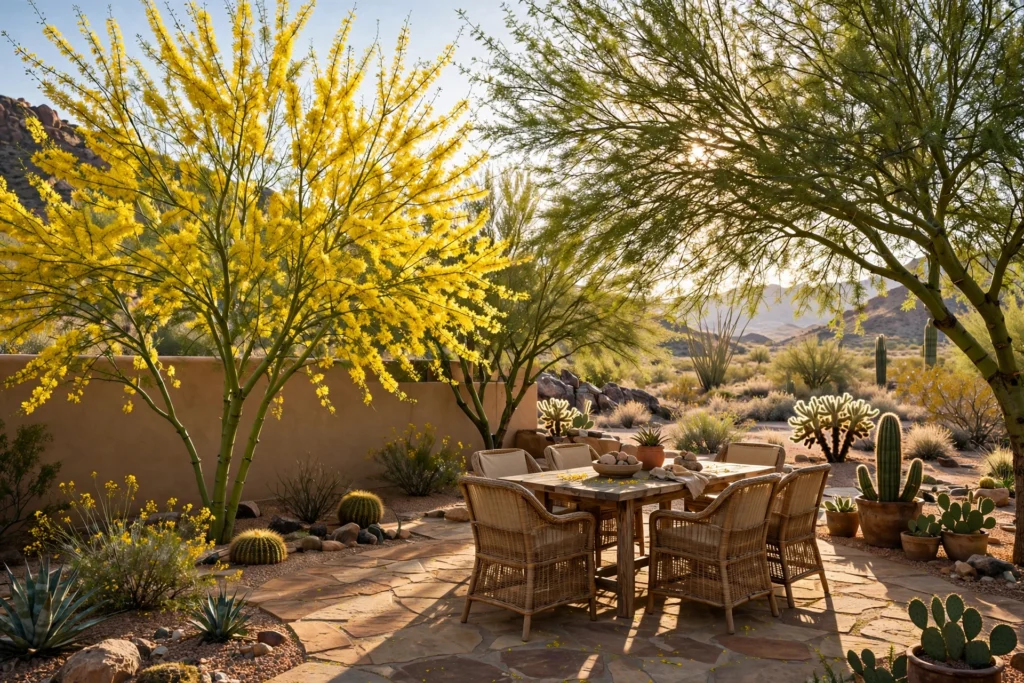
25. Plant Palo Verde and Mesquite Shade Trees
Every Arizona backyard needs real shade trees, and palo verde and mesquite are the two that earned their place over centuries. A palo verde grows fast, blooms in a blaze of yellow flowers each spring, and casts a light, filtered shade that lets grass and groundcover grow underneath. A mesquite grows slower but wider, with a dense canopy that drops the temperature beneath it by ten degrees or more, and its fallen pods make a sweet flour that desert cooks have used for generations.
Plant the trees where their shade will fall on the patio, the west-facing wall of the house, or the play area — not in the middle of the lawn, where their roots will compete with everything else. Water them deeply but infrequently for the first two years, then let them find their own water, because both species grow stronger and more drought-tolerant when they are not babied. In five years, the tree you planted today will be the reason the backyard is usable in July.
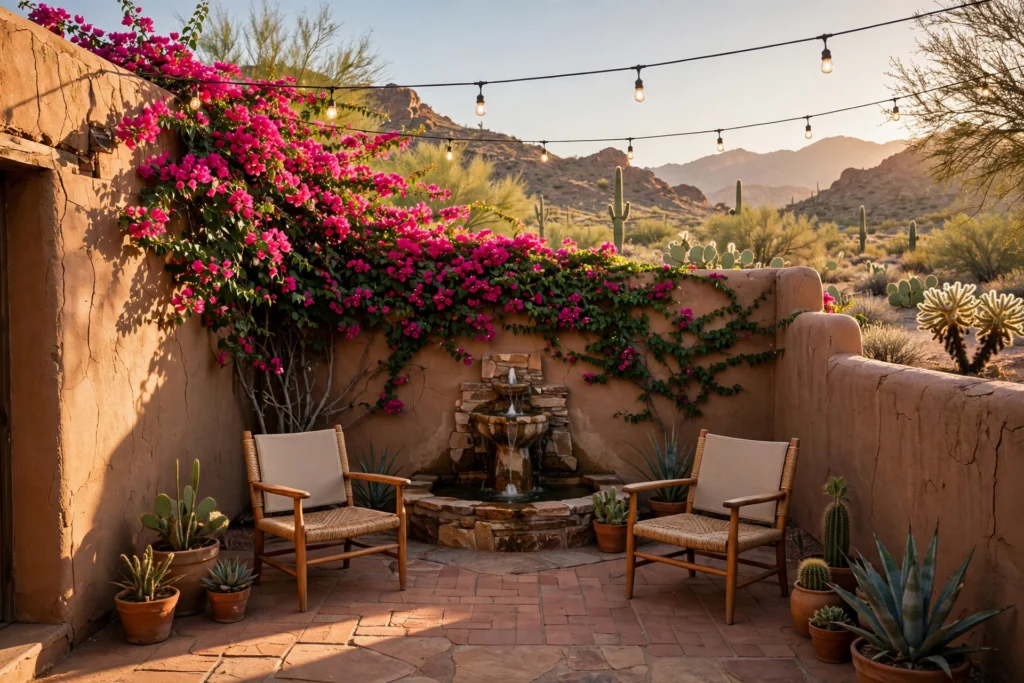
26. Enclose an Adobe-Walled Courtyard
A low adobe or stucco wall turns an open backyard into a courtyard — a private outdoor room that blocks the wind, traps the cool evening air, and gives the garden a sense of enclosure that an open yard never has. Build the wall three to four feet high, with a rounded cap and a warm earth-tone plaster that matches the house, and leave a wide arched opening on the garden side so the courtyard still connects to the rest of the yard. Inside, the wall creates a microclimate: plants grow a little lusher, the fountain sounds a little louder, and the space feels sheltered even on a windy afternoon.
Furnish the courtyard like a room: a small fountain or bubbling rock at the center, a pair of chairs and a side table, and pots of bougainvillea climbing the wall for a splash of magenta. A string of lights overhead and a fire bowl in the corner make it the evening gathering spot, and in the morning it is the sunniest, warmest place in the yard. It is the closest thing to a Mediterranean courtyard the desert allows — and it suits Arizona perfectly.
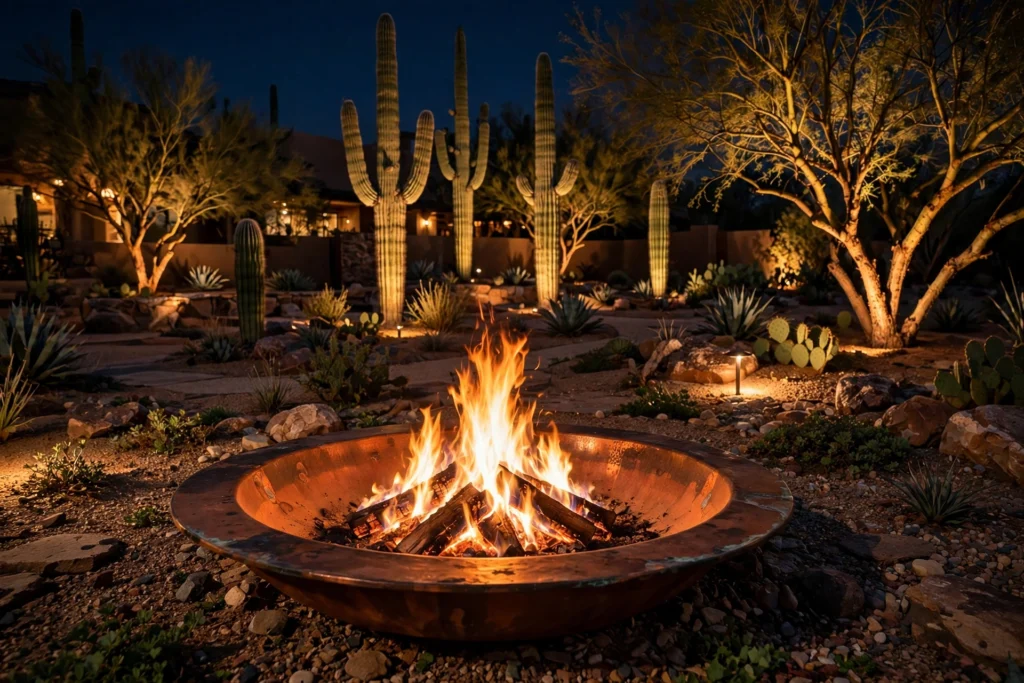
27. Finish With a Fire Bowl and Landscape Lighting
The last layer of any great Arizona backyard is the one you only see after dark: a fire bowl and a thoughtful lighting plan. A wide, low fire bowl on the patio — copper, stone, or cast concrete — gives you flame without the commitment of a full fire pit, and it throws enough light to gather around on a cool desert night. Set it on a stone plinth, keep a lid nearby for windy evenings, and run it on natural gas if you want instant flame with no firewood to store.
Layer the lighting around it: uplights at the base of the saguaro and the shade trees, small path lights along the granite walkways, and a few well lights washing the courtyard wall. Keep every fixture warm white and aimed downward or at a feature, never into anyone’s eyes, and put the whole system on a timer so the yard lights itself at dusk. The result is a backyard that looks even better at nine in the evening than it does at noon — which, in Arizona, is the whole point.
FAQs About Arizona Backyard Ideas
What is the best low-maintenance landscaping for an Arizona backyard?
Xeriscaping with native plants is the lowest-maintenance option: agave, prickly pear, desert marigold, penstemon, and palo verde thrive on drip irrigation and need little pruning or feeding. Decomposed granite paths and gravel beds replace lawn, so there is nothing to mow or water daily, and a dry creek bed handles monsoon rain without any upkeep.
How do I create shade in an Arizona backyard?
Start with a pergola or ramada over the main seating area, add shade sails over the pool or dining table, and plant fast-growing shade trees like palo verde and mesquite for long-term cover. Layering structures and trees together gives you shade at every hour of the day, and a misting system under the pergola drops the temperature further on the hottest afternoons.
What plants survive the Arizona summer heat?
Native and desert-adapted plants handle the heat best: saguaro, blue agave, prickly pear, ocotillo, desert willow, red yucca, lantana, and bougainvillea all thrive in full sun with minimal water. Avoid thirsty lawn grasses and tropical plants that need daily watering and shade, because they struggle from June through September.
How much water does a desert oasis backyard use?
A xeriscaped Arizona backyard typically uses far less water than a lawn — often half or less — because drip irrigation delivers water directly to plant roots and gravel mulch cuts evaporation. Grouping plants by water needs, watering deeply but rarely, and choosing native species keeps the water bill low while the garden still looks lush.
Can I have a pool in a small Arizona backyard?
Yes. A stock tank plunge pool or a small cocktail pool fits in a side yard or a compact patio where a full-size pool never would, and it uses far less water and costs much less to build and maintain. Shade it with a sail, surround it with a low deck, and it becomes the cooling centerpiece of a small desert yard.
When is the best time to plant a desert garden in Arizona?
Fall is the best planting season in Arizona: the soil is still warm, the air is cooling, and new plants have all winter to establish roots before the summer heat arrives. Sow wildflower seed in October, plant trees and cacti from September through November, and save warm-season vegetables and herbs for March after the last frost.
Conclusion
A desert oasis is not a contradiction — it is what an Arizona backyard becomes when you design for the climate instead of against it. Start with shade, choose plants that already love the heat, let stone and gravel carry the structure, and add water in small, smart doses: a bubbling rock, a plunge pool, a misting line. Then finish with the things that make the yard yours — a fire bowl for cool nights, string lights for long evenings, a hammock under the mesquite. Pick one idea from this guide and build it this weekend, and by next spring your backyard will feel less like a yard in the desert and more like the desert’s best-kept secret: your own oasis.
Looking for more outdoor inspiration? See our 33 backyard ideas for general outdoor living, our driveway entrance curb appeal ideas for the front of the house, and our DIY banquette seating ideas for a cozy outdoor dining nook.