
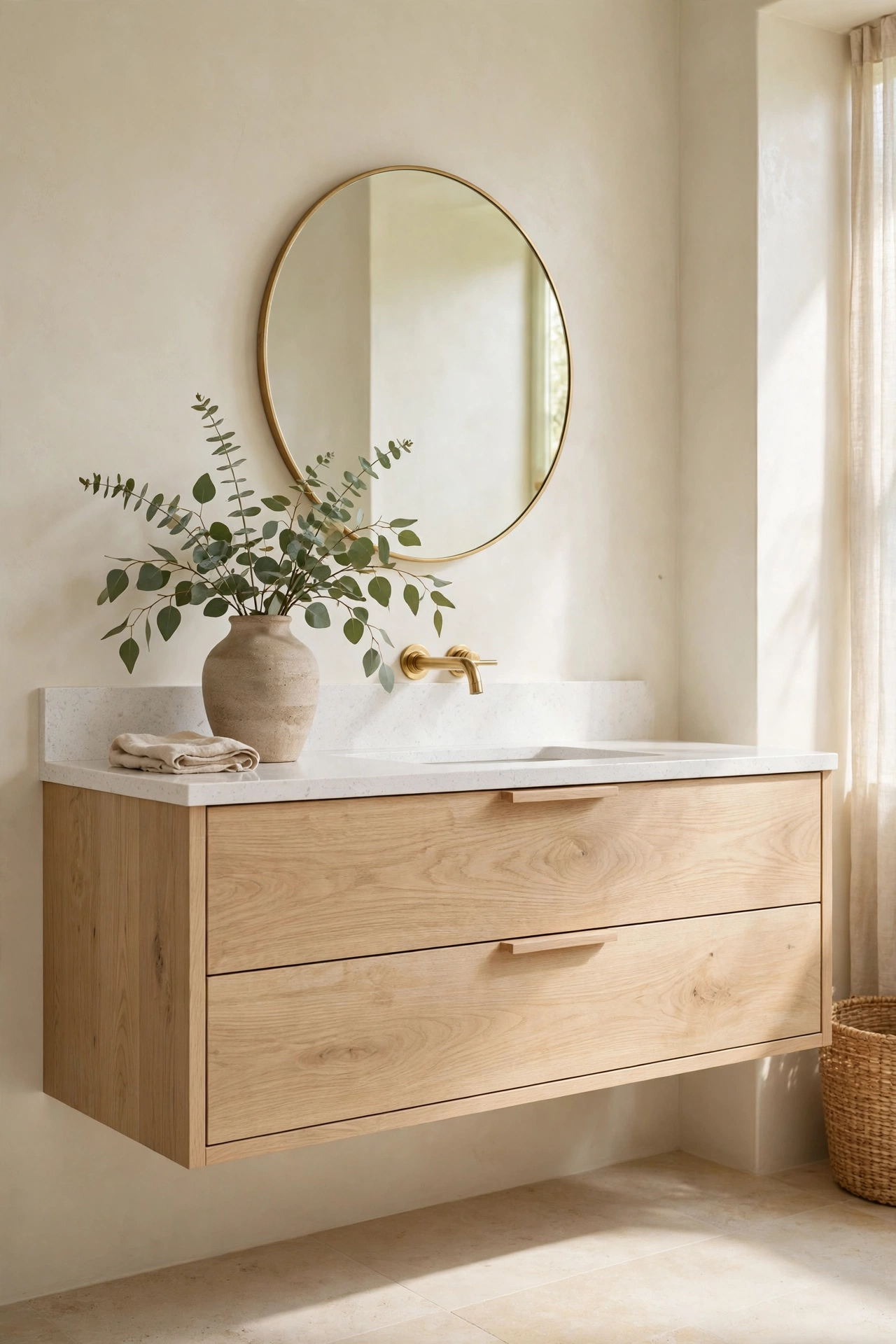
23 White Oak Bathroom Vanity Ideas for a Warm, Spa-Like Retreat
White oak has quietly become the wood species designers reach for when a bathroom needs to feel warm without feeling heavy. Its pale honey tone and tight, straight grain bring natural texture into rooms that are otherwise full of hard, glossy surfaces — tile, porcelain, glass — and it pairs effortlessly with both modern minimalism and classic styling. A white oak bathroom vanity anchors the room with organic character, whether you choose a floating silhouette, a furniture-style double sink, or a compact powder-room piece.
This roundup gathers 23 genuinely distinct ways to style a white oak vanity, from countertop pairings and hardware finishes to storage configurations and lighting companions. Every idea is a standalone design direction you can adapt to your floor plan, budget, and bath size — so browse the full list, save the ones that fit your vision, and bring that calm, spa-like warmth home.
1. Floating White Oak Vanity With a Wall-Mounted Faucet
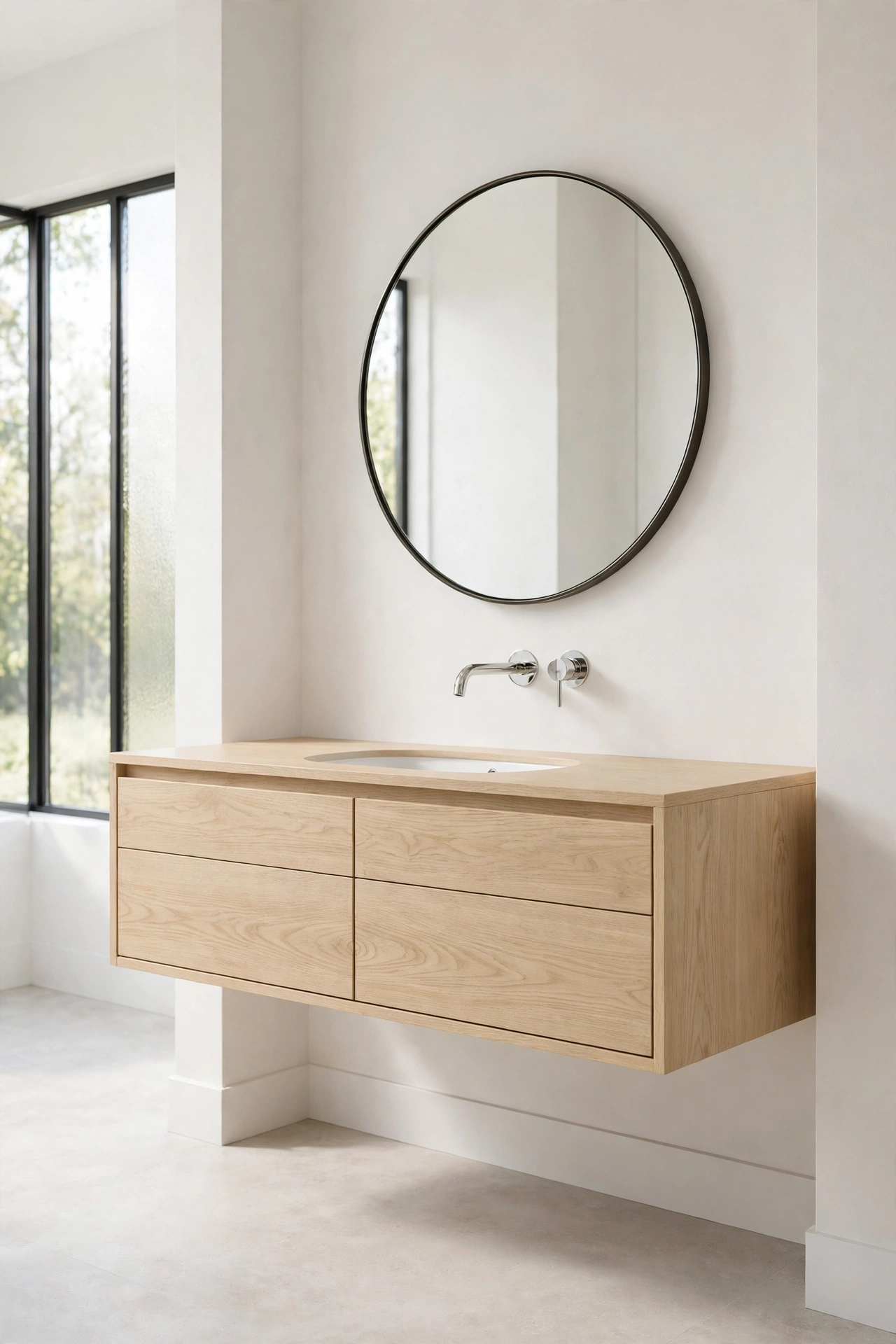
Mounting a white oak vanity to the wall and pairing it with a wall-mounted faucet creates one of the cleanest looks in modern bathroom design. The floating cabinet keeps the floor visible, which makes small bathrooms read larger, and it makes mopping around the base effortless. Choose a slab-front floating unit with a rift-sawn oak veneer for a sleek, linear grain, and position the faucet spout so it clears the vessel or undermount sink comfortably. The open space underneath also gives you a handy styling shelf for a folded stack of towels or a small basket. Keep plumbing in mind: wall-hung units need solid blocking inside the wall, so plan this before tile goes up, and ask your plumber about an in-wall carrier or a shallow trap to maximize the usable drawer space.
2. White Oak Double Vanity for Shared Bathrooms
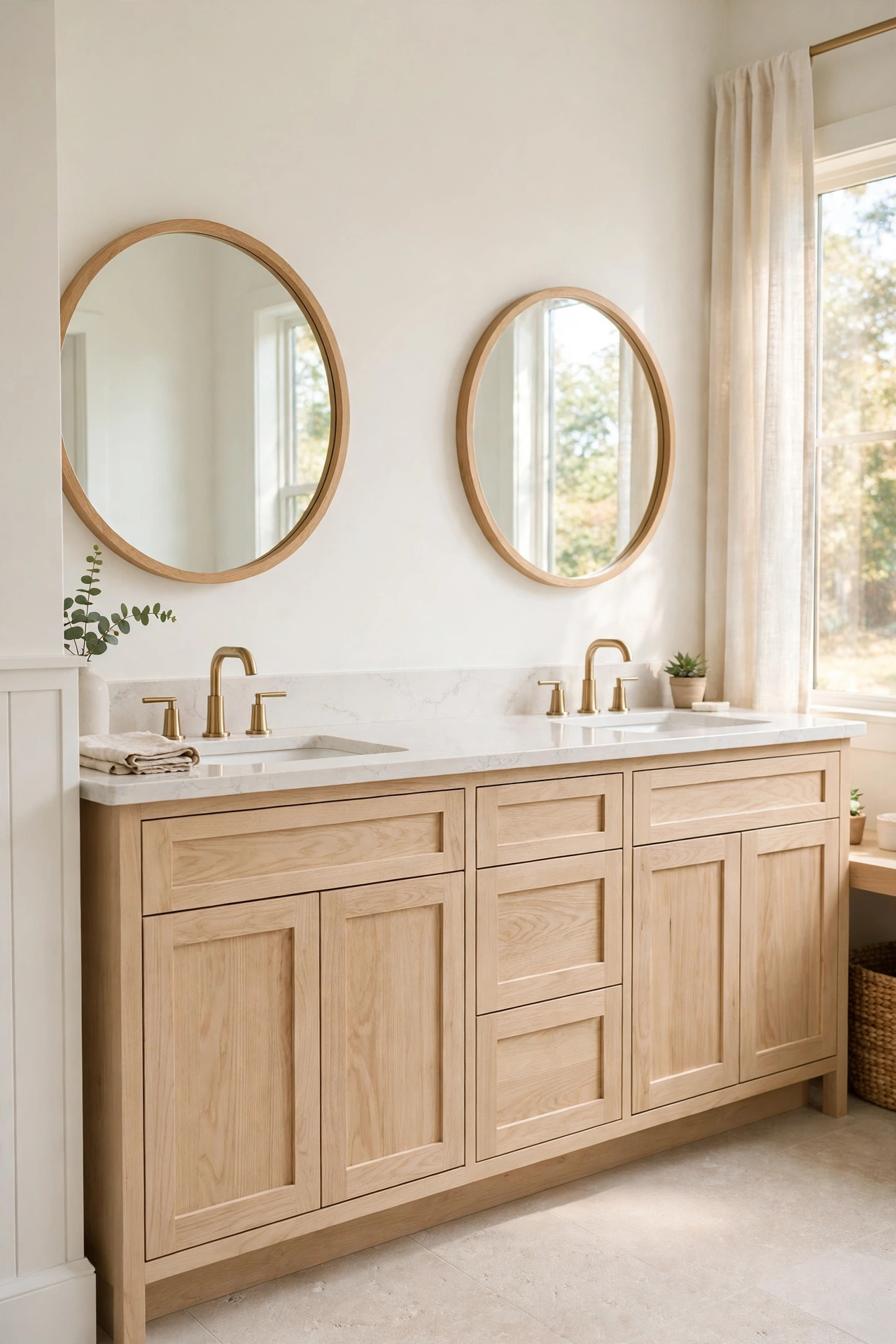
A double white oak vanity turns the morning rush into something civilized. Look for a 60- to 72-inch cabinet with two full drawer banks so each person gets dedicated storage — a divided top drawer with hair-tool organizers on one side and a cosmetics tray on the other keeps countertops clear. White oak’s natural variation hides water spots and toothpaste specks far better than a glossy painted finish, which is a quiet advantage in a busy family bath. Style the pair of mirrors above — two round mirrors or one long trough mirror both work — and add a runner rug in a warm neutral to soften all the hard surfaces. If the budget is tight, buy the oak base and top it with a single long quartz remnant cut with two sink openings rather than two separate slabs.
3. White Oak Vanity Topped With Quartz
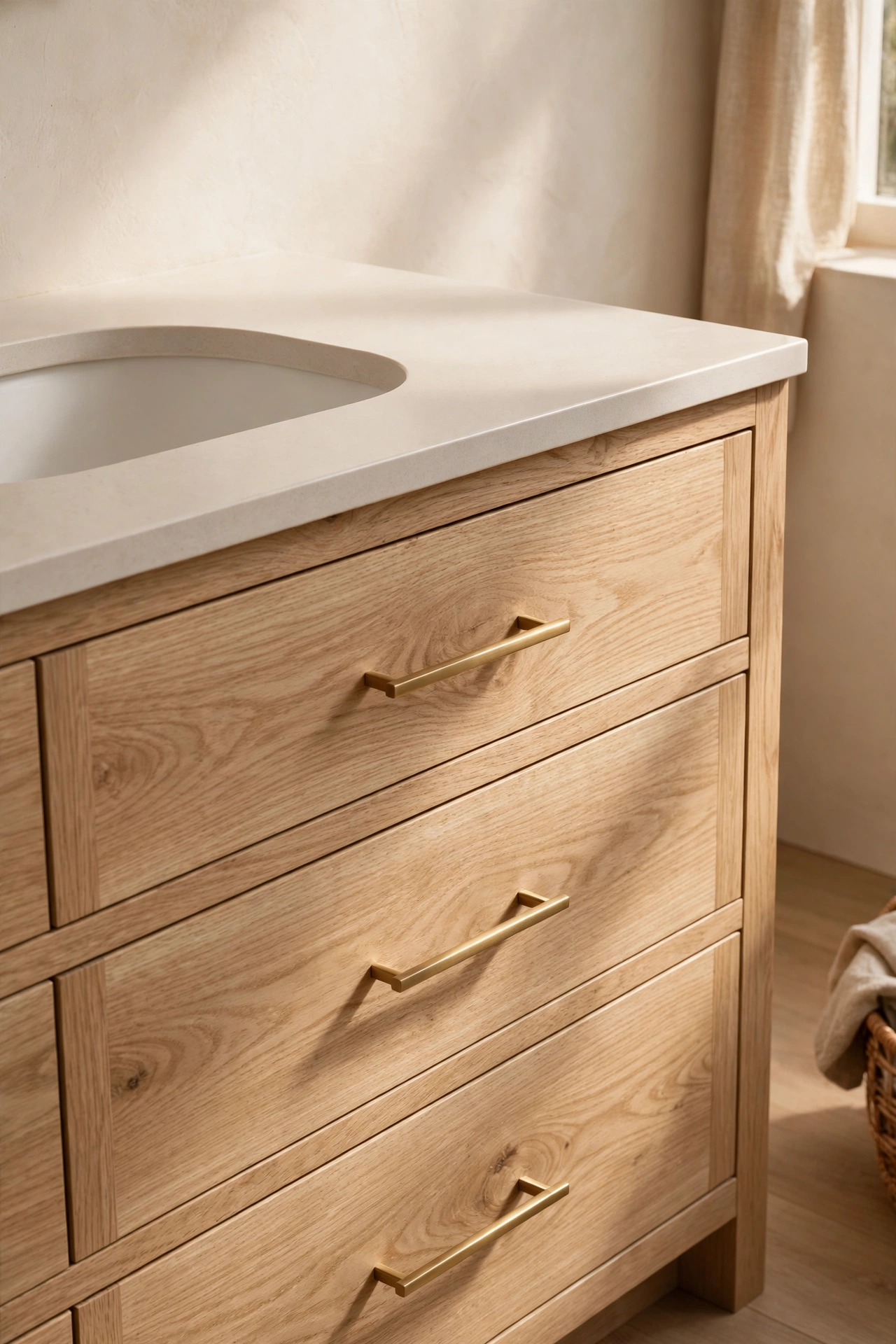
Quartz is the practical partner white oak deserves: non-porous, stain-resistant, and available in warm whites and soft veining that echo the wood’s honeyed tone. A honed quartz top with a slim 3/4-inch edge keeps the vanity feeling tailored rather than bulky, and it shrugs off the setting sprays, dyes, and toothpaste that live around bathroom sinks. For a more luxurious read, step up to a mitered 2-inch edge — the thick profile reads like solid stone and gives the oak base a furniture-grade presence. Keep the palette tonal: pair a warm-white quartz with the oak and brushed brass hardware for a cohesive glow, or go high-contrast with a charcoal-veined quartz against the pale wood. Either way, seal the wood-to-stone junction with a thin bead of color-matched silicone to keep water out of the seam.
4. High-Contrast Pairing: White Oak and Matte Black Hardware
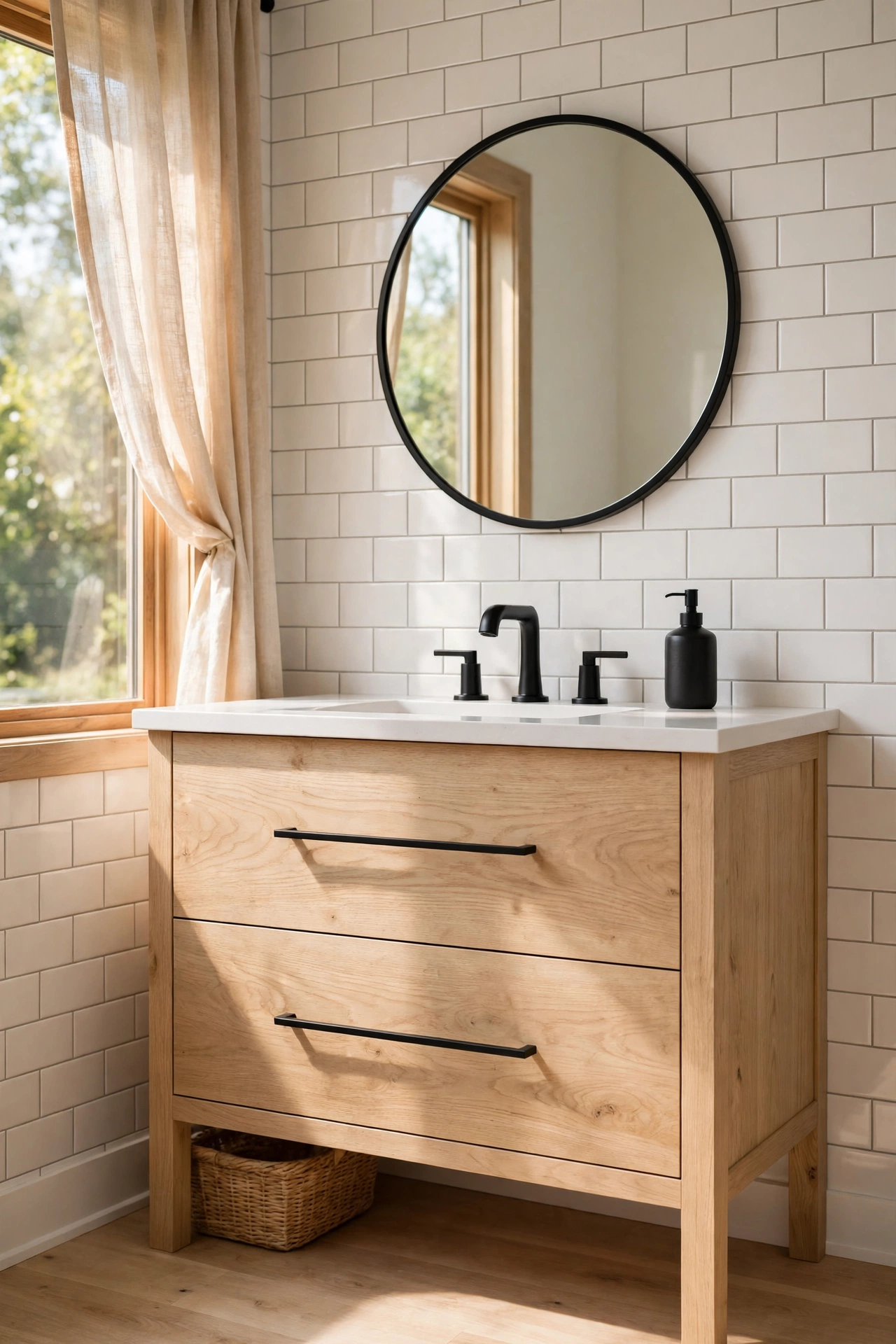
Few combinations are as instantly graphic as pale white oak against matte black pulls, faucets, and mirror frames. The contrast sharpens the wood’s natural warmth and gives the vanity a modern edge without any additional pattern. Stick with one black finish family — matte black knobs, a matte black widespread faucet, and a thin black-framed mirror — so the look feels intentional rather than assembled. Long bar pulls on wide drawers emphasize the horizontal grain of rift-sawn oak beautifully. Because black fixtures show water spots more readily than chrome, keep a microfiber cloth under the sink for a quick wipe-down; the maintenance is minor and the visual payoff is significant. This pairing works especially well in bathrooms with black-framed shower glass or black window trim, tying the whole room together.
5. Fluted White Oak Drawer Fronts for Texture
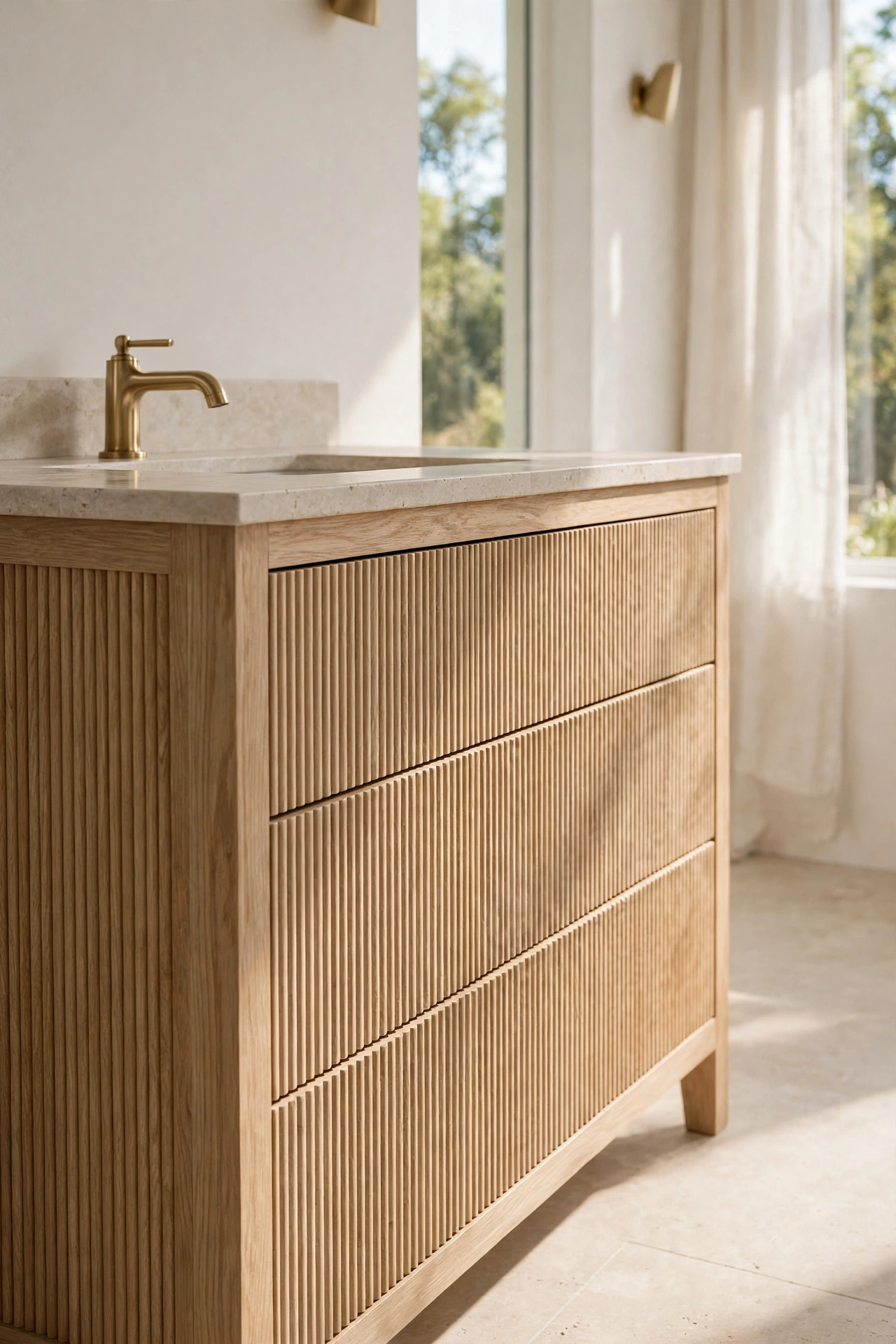
Fluted — or reeded — drawer fronts carve vertical grooves into the oak, adding shadow-line texture that flat slab fronts can’t match. On a white oak vanity, fluting turns the cabinet into the room’s focal point, catching light differently throughout the day as the sun moves. It works in modern, transitional, and even coastal bathrooms because the texture reads as craftsmanship rather than ornament. Keep the rest of the vanity quiet: a simple stone top, an unframed mirror, and minimal hardware (or push-to-open drawers) let the fluting do the talking. One caution: flutes collect dust in their grooves, so plan on a soft brush pass during your regular bathroom wipe-down. Semi-custom cabinet lines now offer fluted oak fronts at reasonable prices, so this look is no longer reserved for fully custom builds.
6. Open Bottom Shelf for Towel Display
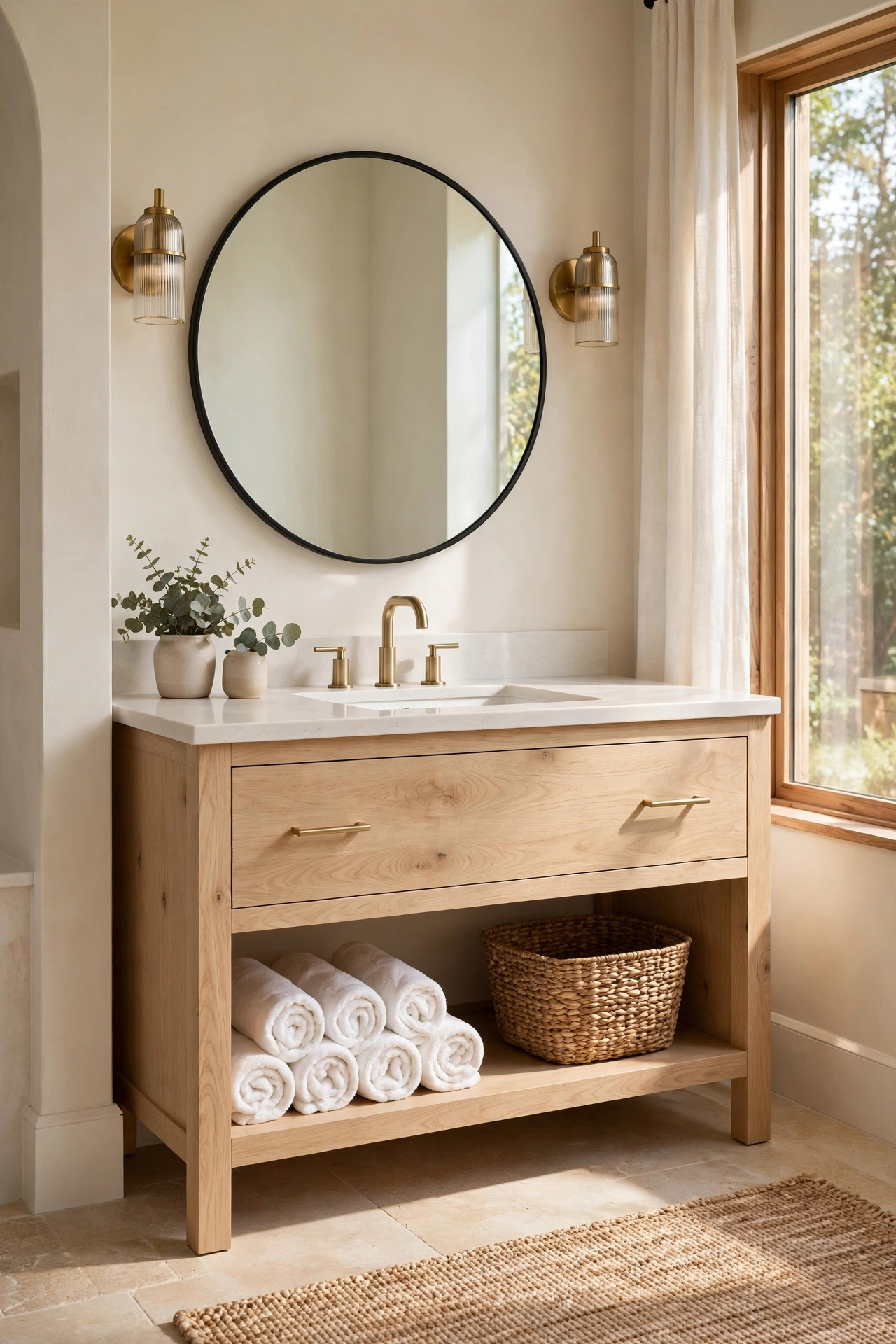
Swapping the lowest drawer bank for an open shelf transforms a white oak vanity into a display piece. Rolled white towels, a woven basket of washcloths, or a small stack of apothecary jars turn storage into styling, and the open space keeps the cabinet from feeling like a solid block. This works best in primary baths and powder rooms where the shelf stays tidy; in a kids’ bathroom, the same shelf can corral bath toys in labeled bins. Have the shelf made from the same oak with a water-resistant finish, and keep a small tray under anything that might drip. For balance, style the shelf in threes — a stack of towels, a lidded basket, and one decorative object like a small plant or stone soap dish — so it looks curated rather than cluttered.
7. Corner White Oak Vanity for Awkward Layouts
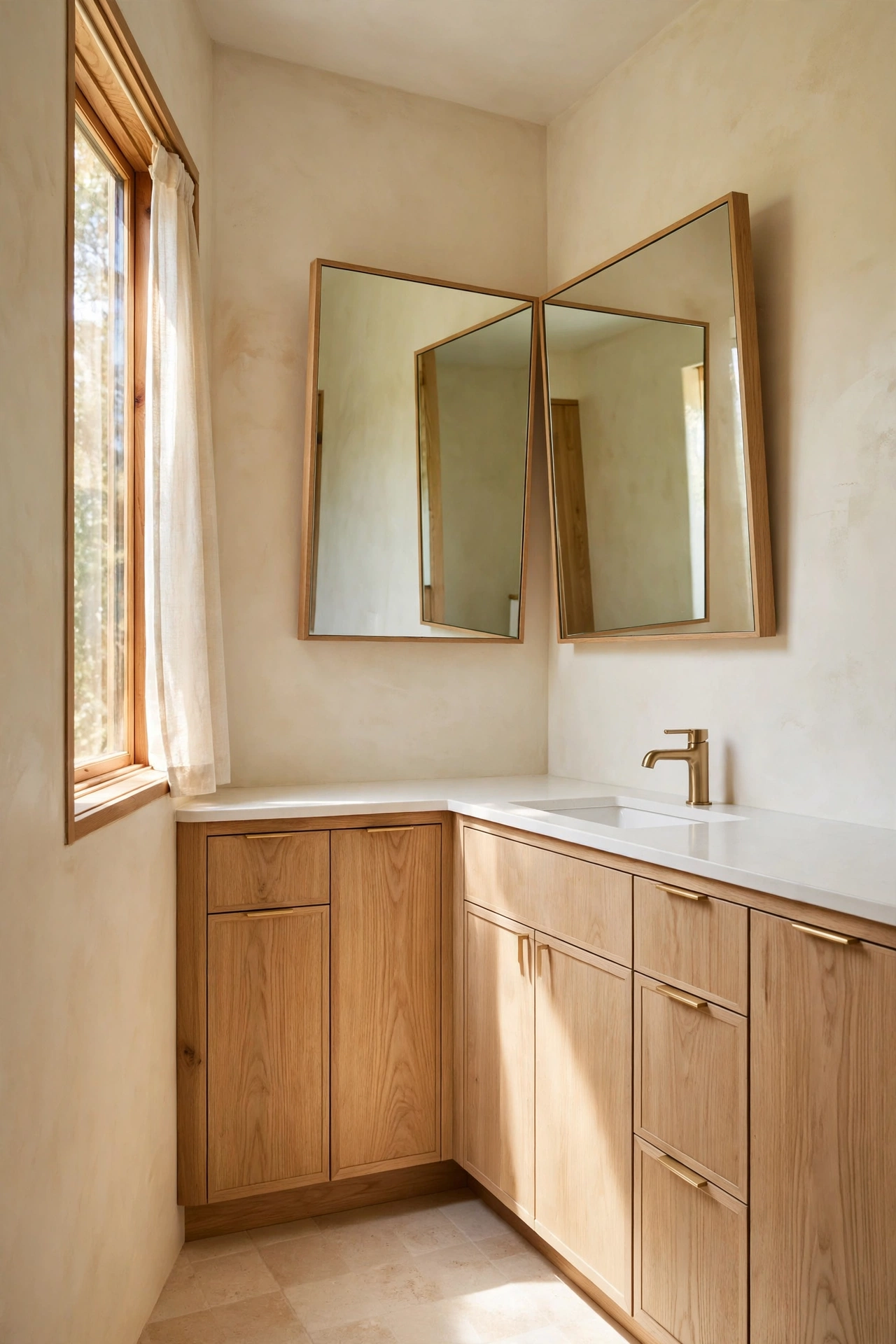
Corner bathrooms — the kind with a door swing that eats the wall or a jog in the footprint — are where a corner white oak vanity earns its keep. A tapered or L-shaped oak unit tucks into the dead corner, reclaiming square footage that a rectangular vanity would waste. The warm wood softens what can otherwise feel like a makeshift solution, making the corner look like a deliberate design choice. Pair it with a corner mirror or two angled mirrors to bounce light into the tight spot, and choose a wall-mounted faucet to preserve the slim counter depth. Storage will be shallower than a standard vanity, so compensate with a mirrored medicine cabinet above or a narrow oak tower beside it. Have the unit custom-built or semi-custom, since off-the-shelf corner vanities in white oak are rare.
8. White Oak Vanity With a Vessel Sink on Top
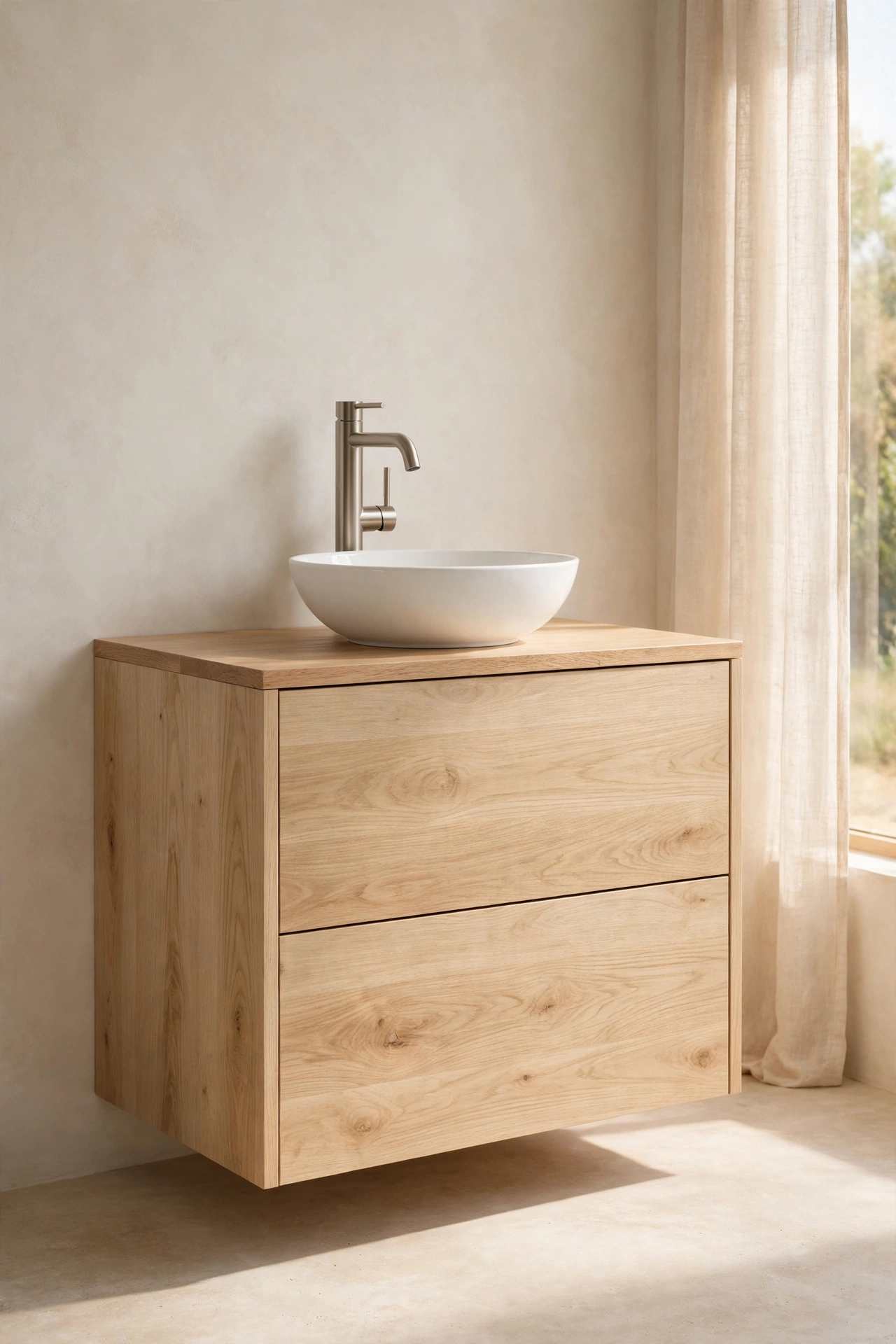
Setting a vessel sink on a white oak vanity turns the basin into a sculptural moment. A white ceramic bowl vessel keeps the look serene and spa-like, while a hammered metal or carved stone vessel adds artisan character — both sit beautifully against the oak’s natural grain. Because the vessel raises the rim height, choose a shorter vanity base (around 30 inches rather than the standard 32-36) or mount a taller faucet so the spout clears the bowl comfortably. The counter around the vessel becomes precious real estate, so keep it minimal: a soap dispenser, a small tray, and nothing else. One practical note: the junction between the vessel and the wood top needs a careful silicone seal, and a marine-grade or conversion-varnish finish on the oak will stand up to the splashes that vessels inevitably invite.
9. Shaker-Style White Oak Vanity Fronts
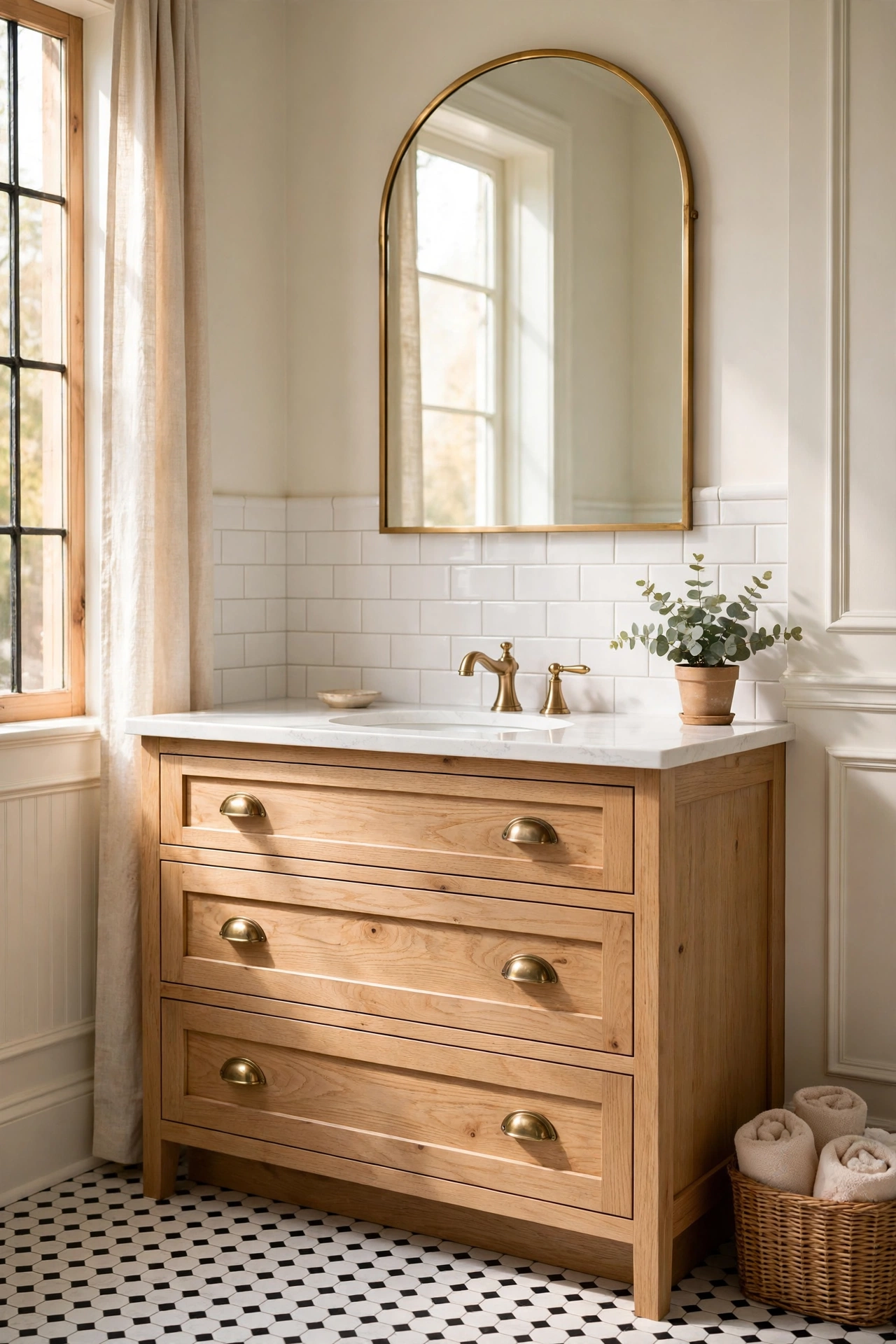
Shaker fronts bring a timeless, crafted feel to a white oak vanity — the recessed center panel shows off the grain while the frame adds quiet structure. In white oak, Shaker styling bridges farmhouse, transitional, and even modern-classic bathrooms, aging far more gracefully than trend-driven slab fronts. Slim the rails and stiles slightly for a fresher take, and choose simple cup pulls or knobs in unlacquered brass that will develop a soft patina over time. A Shaker oak vanity pairs naturally with subway or handmade-look tile and a simple quartz or marble-look top. Because the panel joints can be vulnerable to moisture, make sure the cabinetmaker seals all end grain and uses exterior-rated joinery glue — details that separate a vanity that lasts decades from one that swells at the corners.
10. White Oak Vanity With a Marble-Look Porcelain Top
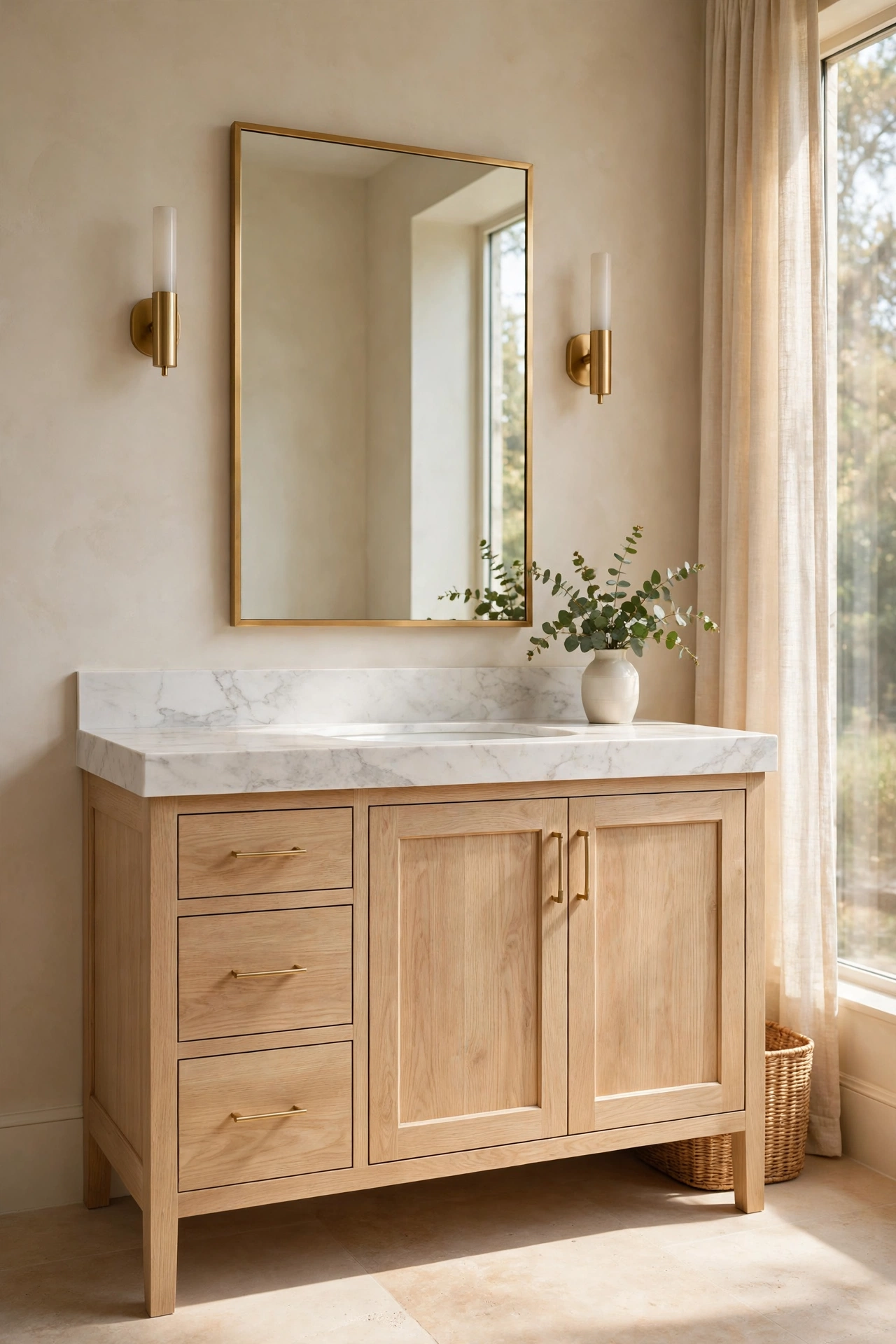
A large-format porcelain slab with marble veining gives you the drama of Calacatta without the etching, staining, or sealing that real marble demands — a smart match for a hardworking white oak vanity. The cool white ground of the porcelain makes the oak’s warm tones pop, and a waterfall or mitered edge in the porcelain adds a gallery-like finish. Undermount the sink so the veining runs uninterrupted across the top, and carry the same porcelain up the wall as a full-height backsplash for a seamless, high-end look. This combination suits modern and transitional bathrooms where you want luxury without fuss. Budget tip: porcelain slabs cost less per square foot than natural marble, and the offcuts can be fabricated into a matching shower curb or window sill for a pulled-together result.
11. Two-Tone Vanity: White Oak Meets a Painted Base
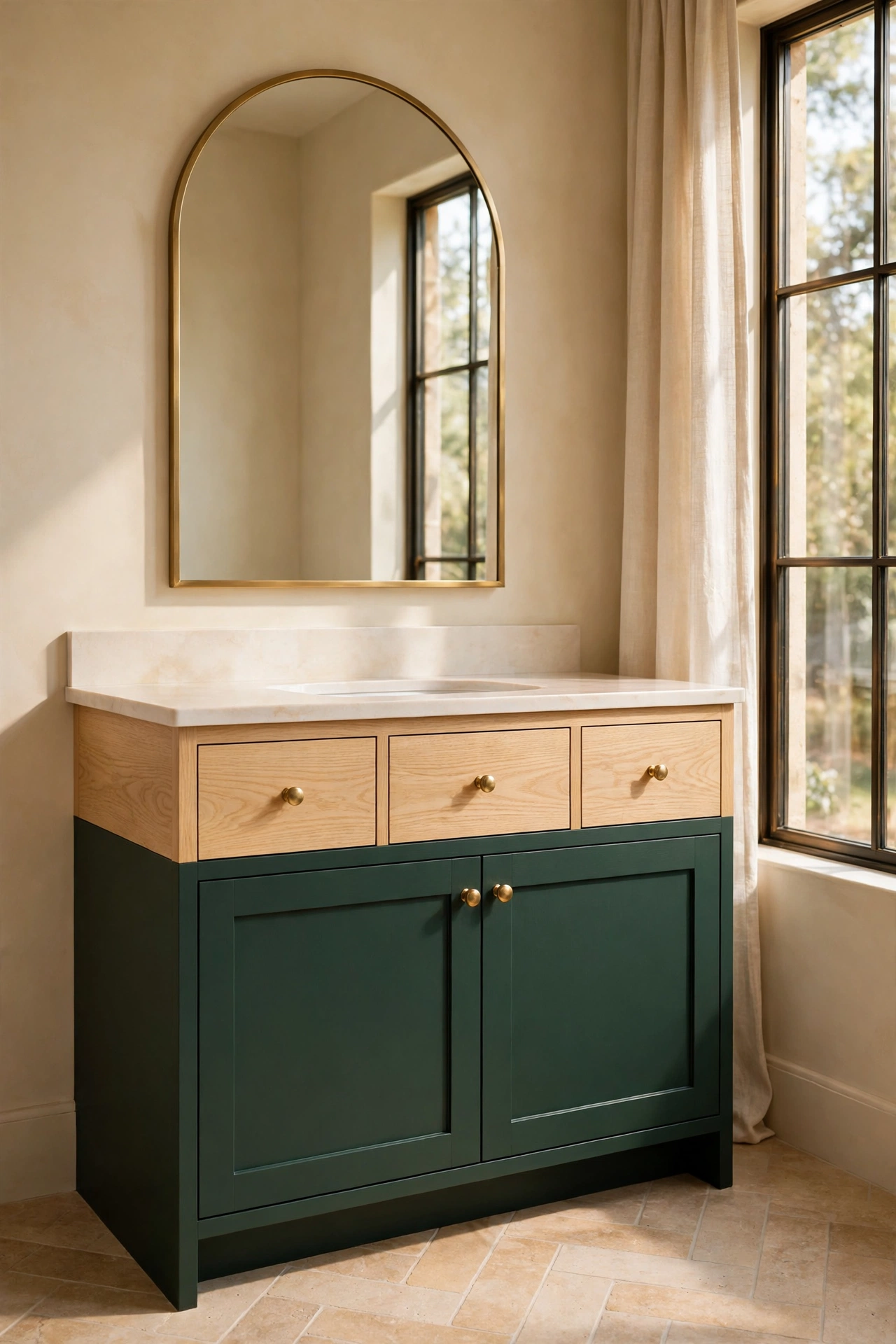
Pairing white oak drawer fronts with a painted cabinet base — deep green, inky navy, or warm charcoal — gives you warmth and color in a single piece. The oak tempers the drama of the dark paint while the paint gives the wood a tailored, furniture-like frame. A common layout: oak on the top drawer bank and painted base below, or an oak-framed cabinet with painted inset panels. Keep the countertop quiet (warm white quartz or honed marble-look porcelain) so the two-tone cabinet stays the star, and echo the paint color in a small accessory — a bath mat, a vase, or the mirror frame — to make the scheme feel deliberate. This is also a clever way to use oak selectively and keep costs down, since you need less of the premium wood.
12. White Oak Vanity With Backlit Mirror Lighting
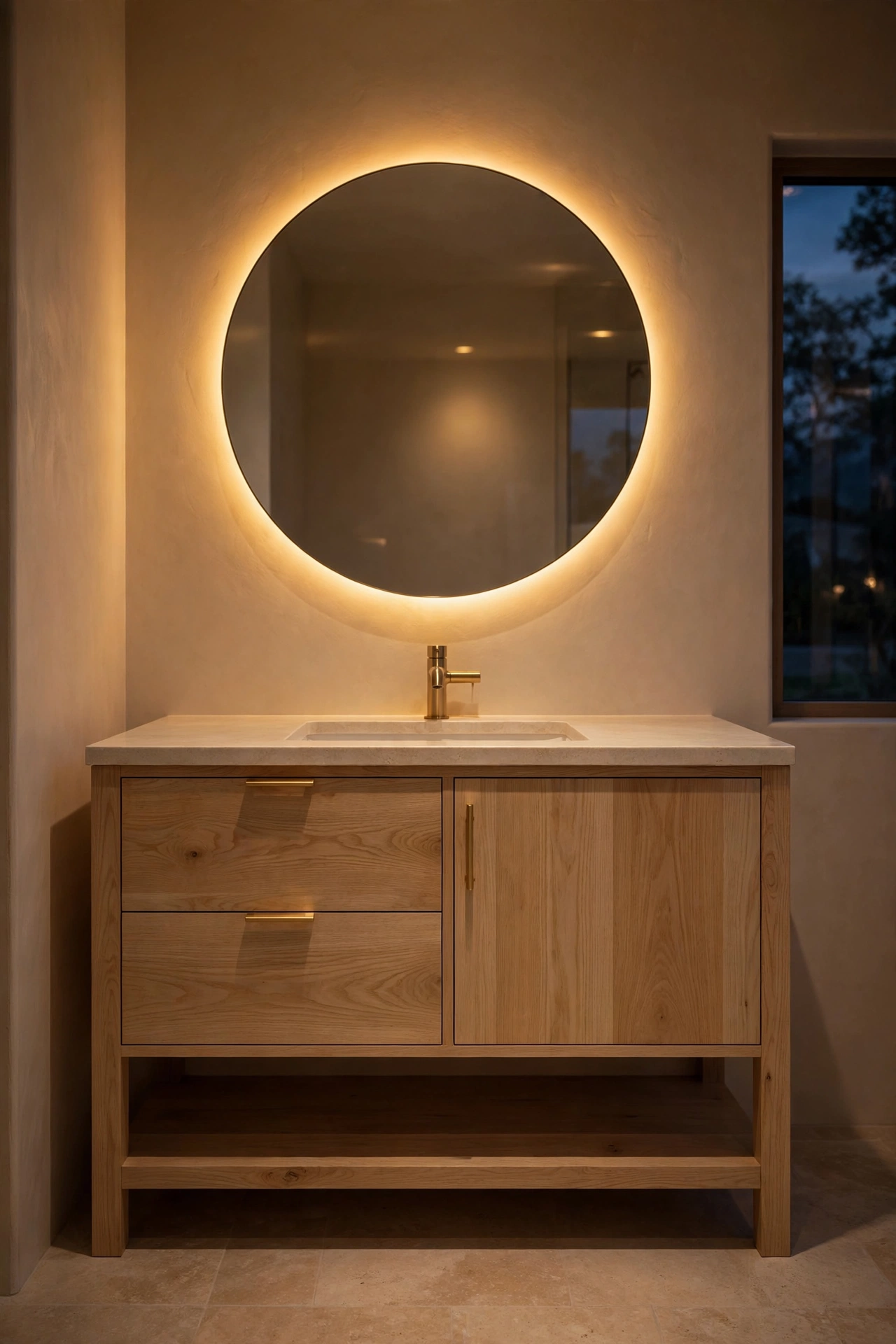
Good lighting makes a white oak vanity glow, and a backlit or LED-framed mirror is the most flattering option. The soft halo of light eliminates the harsh shadows that overhead cans create on faces, which matters for makeup and shaving, while washing the oak with an even, warm light that deepens its grain. Choose a mirror with a 2700–3000K color temperature to keep the oak reading warm rather than gray, and put it on a dimmer so you can drop to a nightlight glow. Pair the backlit mirror with a simple oak slab vanity — the mirror becomes the jewelry and the wood the quiet backdrop. One installation note: backlit mirrors need a switched outlet or hardwired connection behind the mirror, so rough this in during the electrical phase rather than after tile.
13. Reclaimed White Oak Vanity for Rustic-Modern Warmth
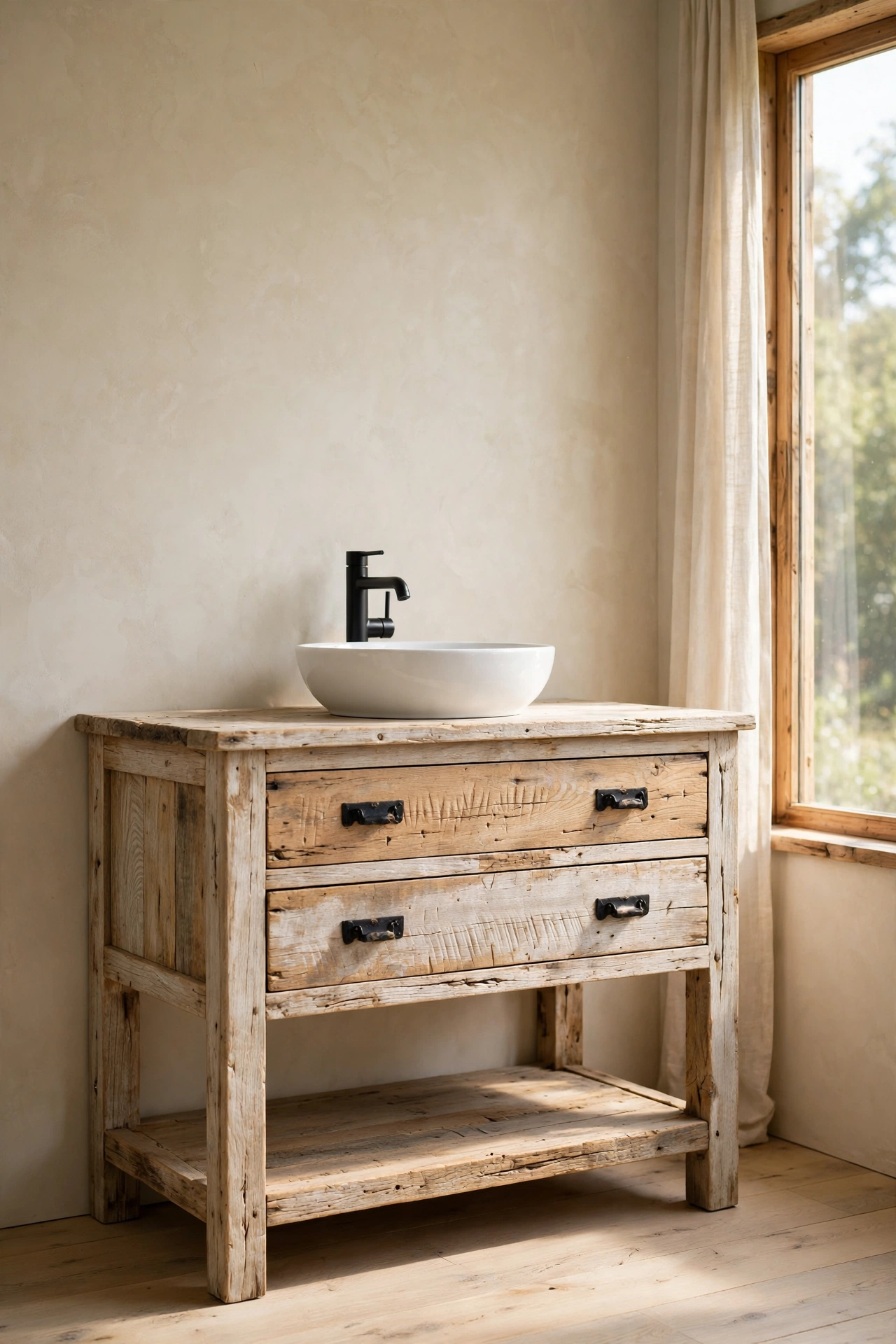
Reclaimed white oak — salvaged from barns, beams, or old flooring — brings saw marks, nail holes, and a depth of patina that new lumber can’t imitate. As a vanity, it becomes the room’s story: a piece with history in a space that’s otherwise brand new. The character marks also hide the dings and water spots of daily life better than a pristine new finish. Source from a reputable reclamation yard that kiln-dries and de-metals the lumber, and finish it with a hardwearing conversion varnish or marine-grade polyurethane so the rustic look doesn’t come with rustic performance. Style it with blackened-steel hardware, a simple white vessel or apron sink, and plaster-look walls for a modern-rustic bathroom that feels collected rather than decorated. Each reclaimed piece is one of a kind, so buy the slab before finalizing the design around it.
14. White Oak Vanity With a Tall Side Storage Tower
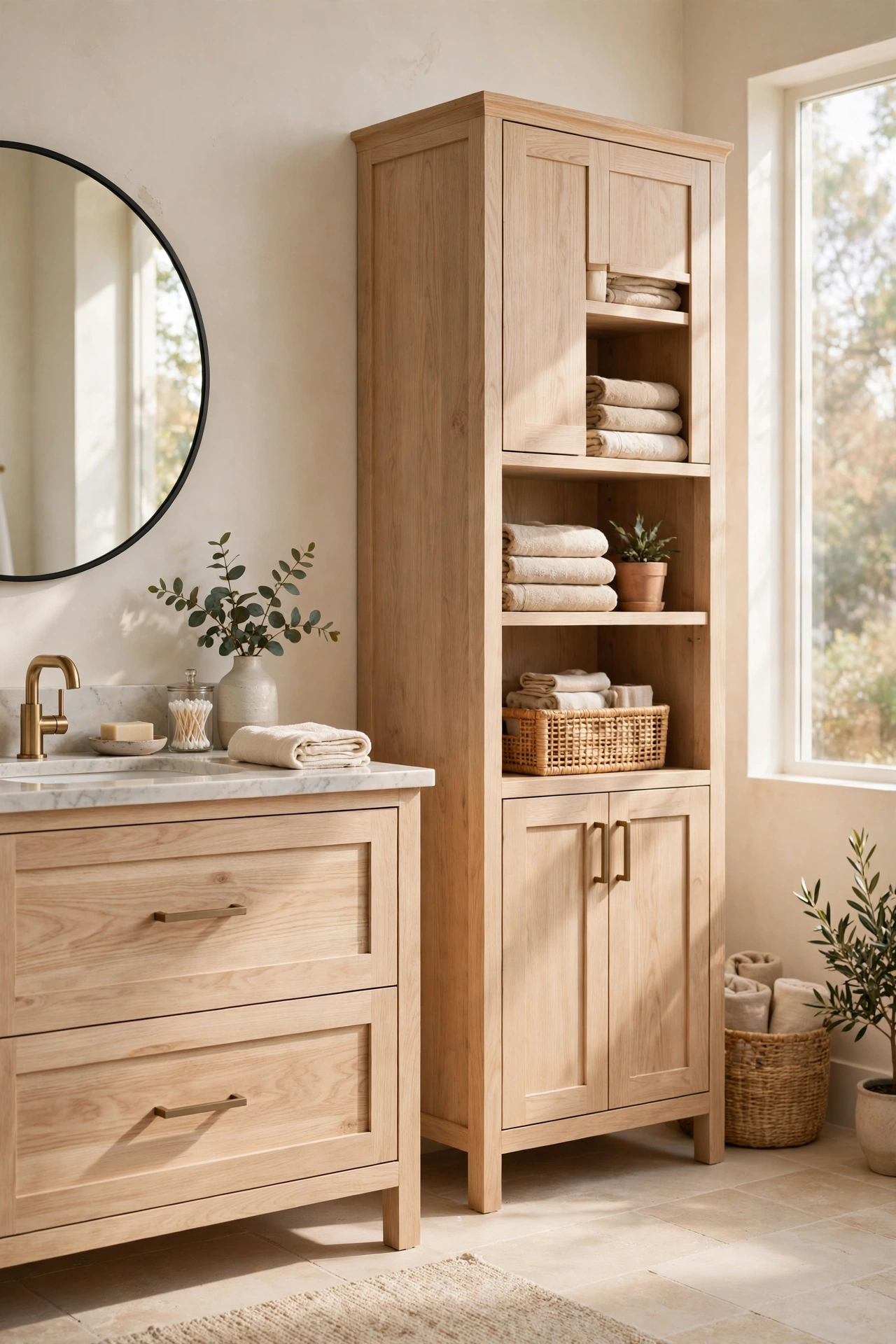
Flanking a white oak vanity with a matching tall tower solves the linen problem in bathrooms with no closet. The tower — typically 12 to 18 inches wide and full height — holds folded towels, toiletries, and cleaning supplies behind closed oak doors, keeping the vanity countertop completely clear. Design the tower as a visual extension of the vanity: same oak, same finish, and aligned toe-kick or floating height so the two read as one built-in. Inside, adjustable shelves plus a couple of pull-out baskets keep deep shelves usable. If the tower would crowd a small bath, try a half-height version that ends at counter level and doubles as a landing spot for a plant or candle. Keep the tower’s doors on soft-close hinges — in a quiet morning bathroom, slammed doors are the enemy.
15. Brass Fixtures Against White Oak
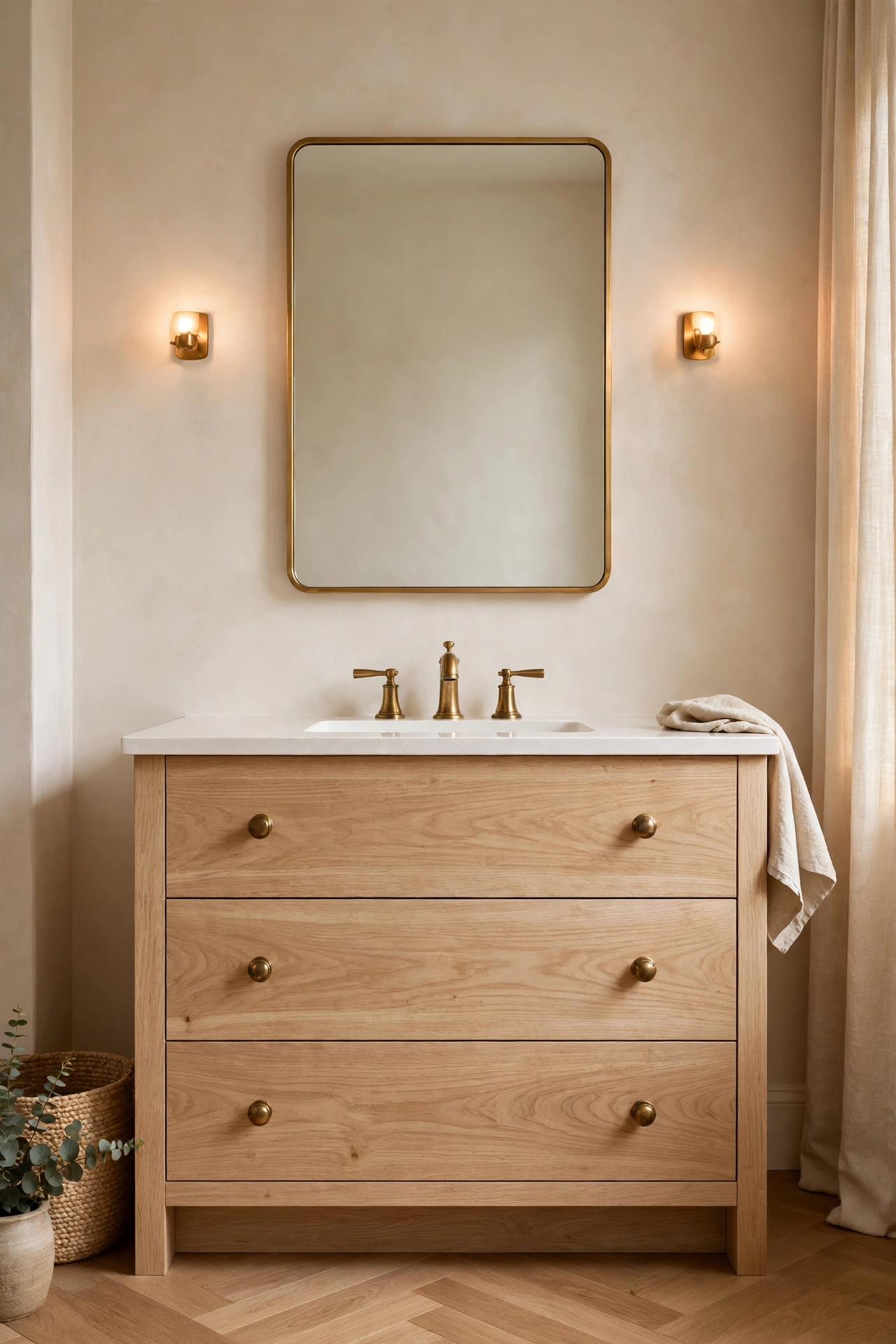
Brass and white oak are a natural pairing — the metal’s golden warmth amplifies the wood’s honeyed undertones instead of fighting them. A widespread brass faucet, brass drawer pulls, and a thin brass-framed mirror create a cohesive jewelry layer over a simple oak vanity. Unlacquered brass will patina to a soft, lived-in finish that suits traditional and transitional baths; lacquered or brushed brass stays bright and reads more modern. To keep the combination from turning yellow-heavy, balance it with cool notes: a white quartz top, pale gray or soft white wall tile, and a natural-fiber rug. Designers have leaned on this exact pairing in warm-wood bathrooms for years — it is one of the most reliably flattering combinations in the book. For inspiration on how pros style wood vanities with metal accents, see Houzz’s roundup of warm wood vanities.
16. Compact Single-Drawer Oak Vanity for Powder Rooms
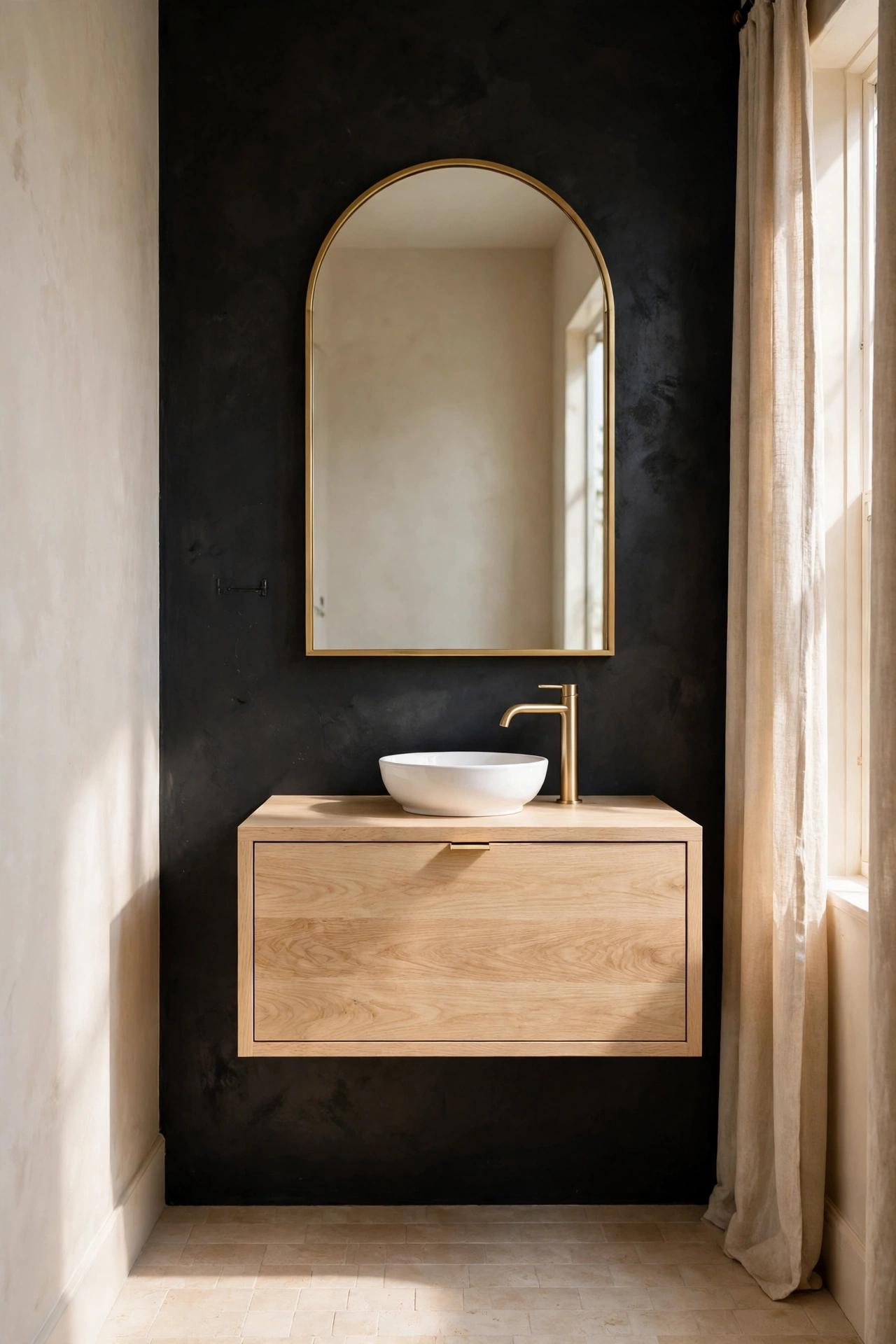
Powder rooms don’t need storage — they need impact — and a compact single-drawer white oak vanity delivers it. A 24- to 30-inch floating oak box with one deep drawer is all the function a guest bath requires, leaving the tiny footprint feeling open while the wood adds the warmth powder rooms often lack. Top it with a stone remnant and a petite vessel or wall-mount faucet, and hang a statement mirror above: an arch, an asymmetric shape, or an ornate vintage frame all play beautifully against the simple oak. Because guests see this room up close, splurge on the details — a beautiful faucet, a real stone top, a small piece of art. The single drawer keeps plumbing simple, and the floating mount makes the little room feel twice its size.
17. Arched Mirror Over a White Oak Vanity
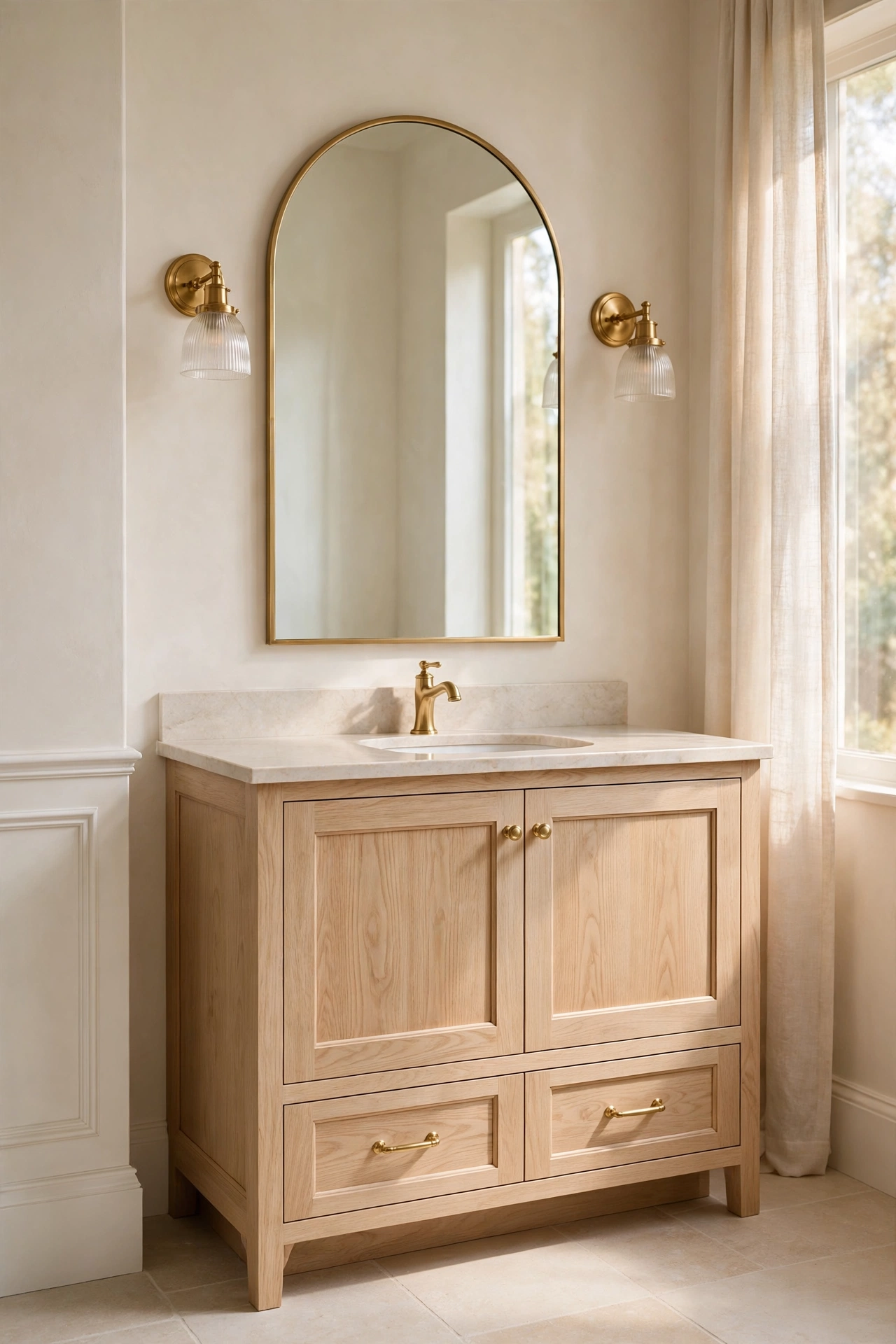
An arched mirror softens the straight lines of a white oak vanity and introduces one of the most flattering shapes in bathroom design. The curve echoes the organic feel of the wood grain while adding a gentle, almost furniture-like elegance — no frame needed, though a thin brass or black arch frame sharpens the look. Scale matters: the arch should be roughly two-thirds the width of the vanity and tall enough to reflect light deep into the room. Pair the mirror with simple sconces mounted at eye level on either side (or one statement pendant in a powder room) so the arch stays the focal point. This combination — oak base, arched mirror, warm metal lighting — works across modern organic, transitional, and soft contemporary bathrooms with almost no risk of looking dated.
18. White Oak Vanity With a Zellige Tile Backsplash
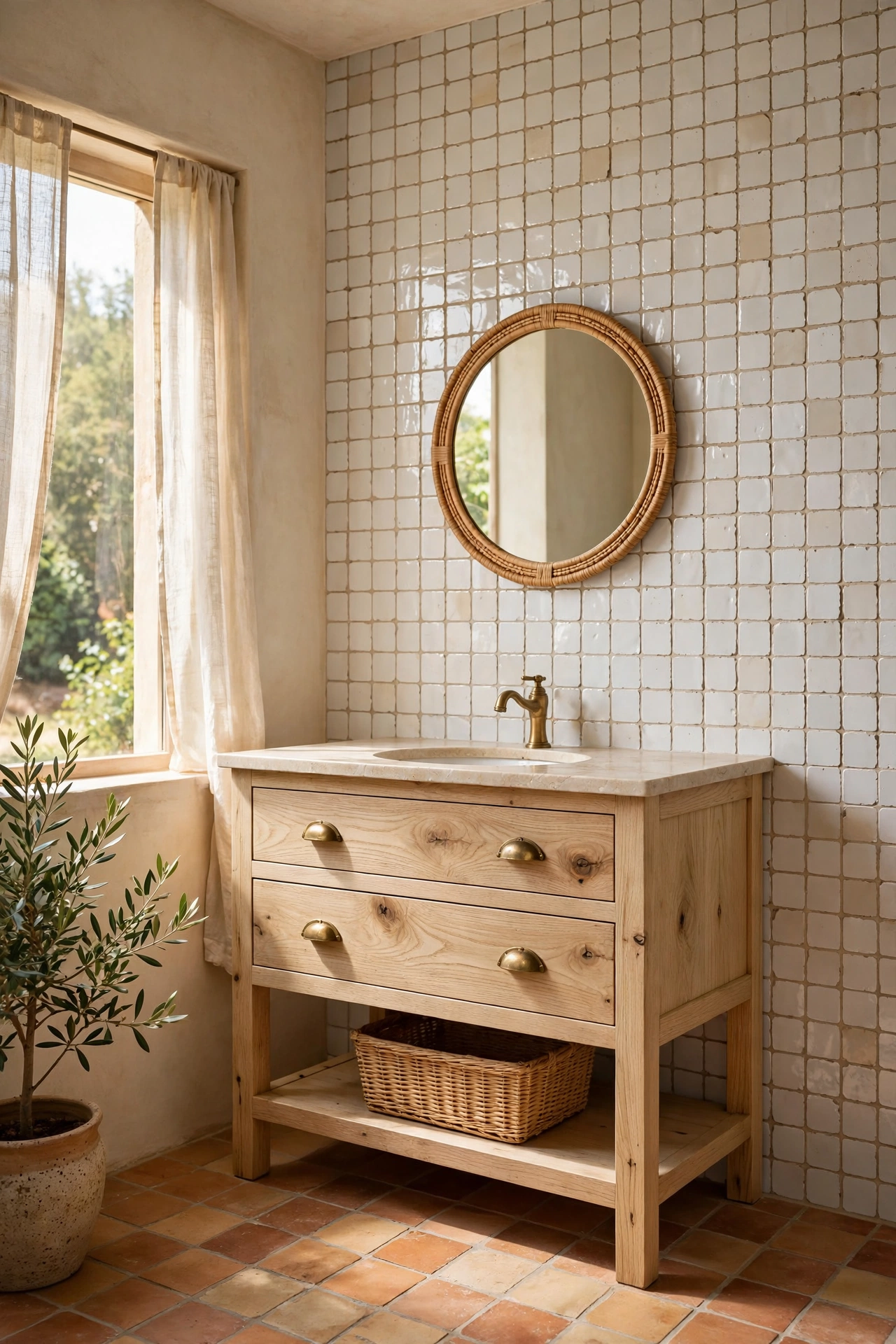
Handmade-look zellige tile brings artisanal variation that plays beautifully against the natural grain of white oak. The tiles’ uneven surface catches light in a way flat ceramic can’t, giving the vanity wall a living, shimmering quality. Choose a soft white or warm neutral zellige so the oak remains the warmest element in the room, and run it from counter to ceiling behind the vanity for maximum effect — or stop at a simple pencil liner for a more restrained look. If handmade Moroccan tile stretches the budget, the same idea works with a handmade-look subway tile: you keep the variation and the glow at a fraction of the cost. For more tile-pairing inspiration, browse our farmhouse backsplash ideas — many of the same principles apply behind a bathroom vanity.
19. White Oak Vanity With a Concrete-Look Top
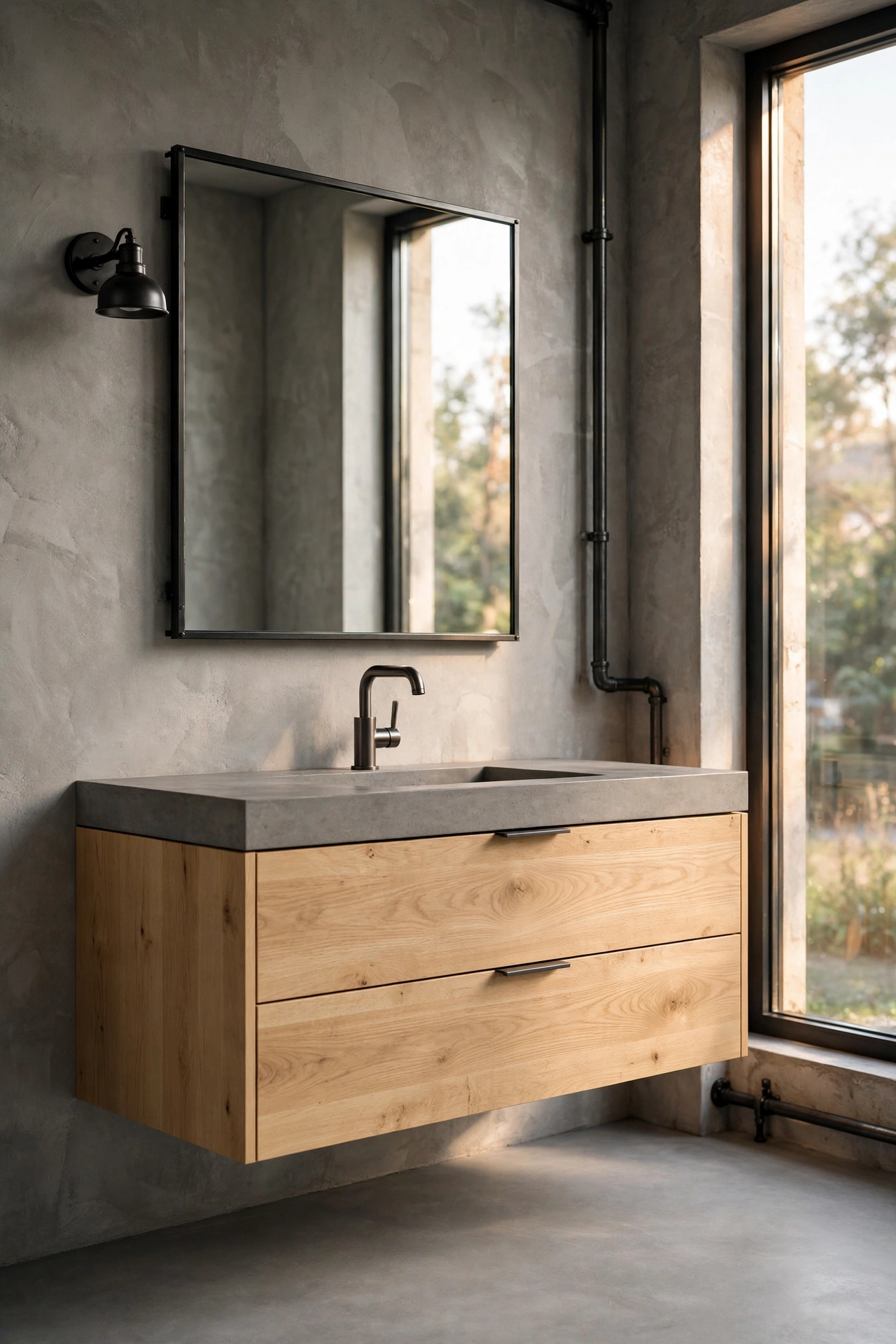
A concrete-look top — real cast concrete or a convincing porcelain — gives a white oak vanity an industrial-modern edge. The cool gray surface makes the oak’s warmth read even richer by contrast, and the matte, tactile finish feels contemporary without the coldness of polished stone. Real concrete needs regular sealing in a wet zone and will develop a patina of use (some love this; some don’t), so a concrete-look porcelain slab is the lower-maintenance route with nearly the same aesthetic. Keep the cabinet lines simple — a floating slab-front oak unit lets the two materials speak clearly — and add black or gunmetal fixtures to complete the industrial story. This pairing shines in loft-style and modern farmhouse bathrooms where a little rawness is welcome.
20. Hidden Electrical Drawer: A Charging Station Inside the Vanity
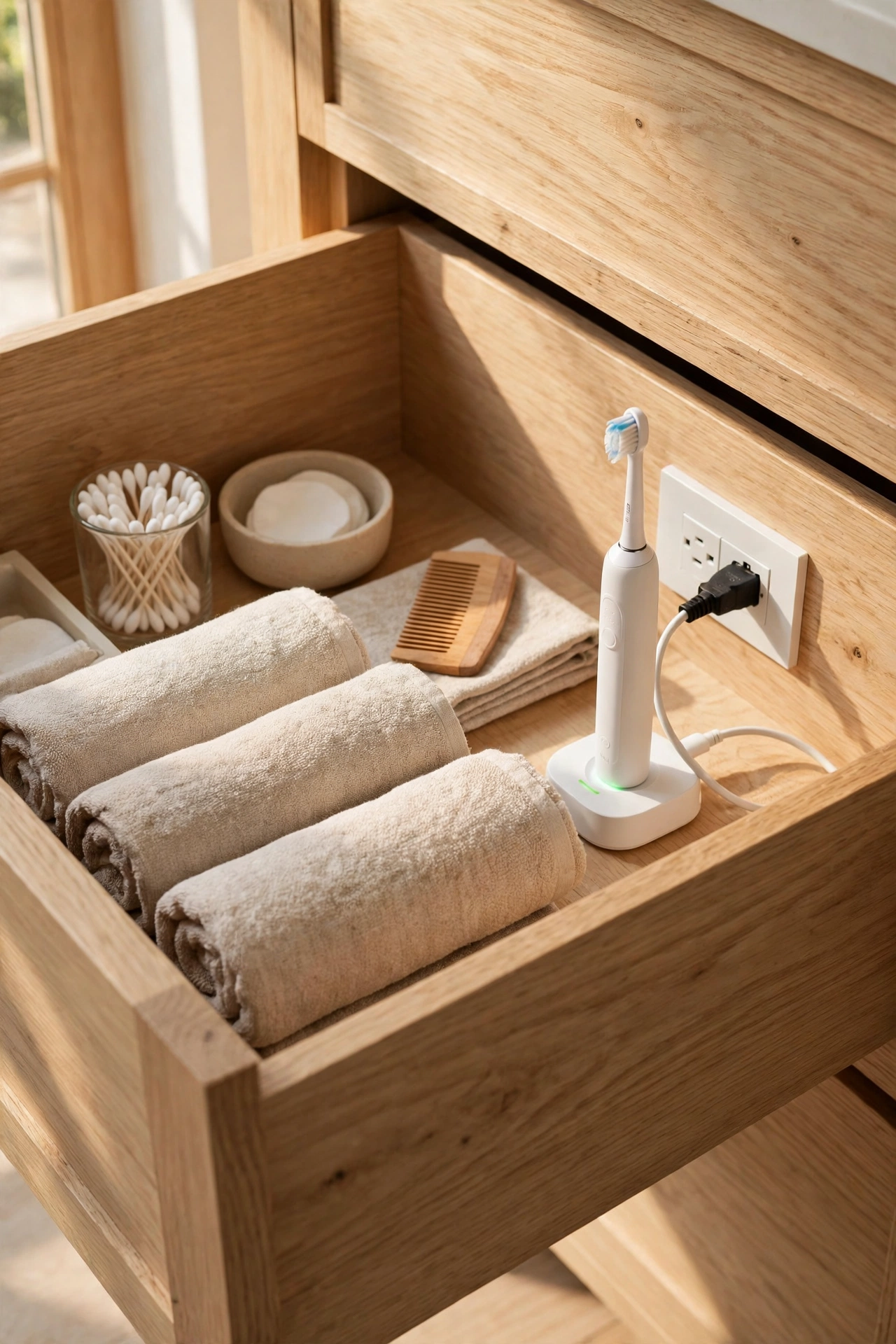
The smartest white oak vanity is the one that hides its clutter: a top drawer fitted with an electrical outlet and USB ports becomes a docking station for electric toothbrushes, shavers, and hair tools. Everything charges out of sight, the countertop stays clear, and cords never drape across the oak top where water pools. Specify a UL-listed in-drawer outlet kit with a cord-management arm that moves with the drawer, and have the electrician run a dedicated outlet inside the cabinet during rough-in. The drawer box itself should be oak or oak-veneered so the surprise inside matches the beauty outside — line it with a heat-resistant mat on the styling-tool side. This is a small upgrade with outsized daily impact, and it photographs as the kind of thoughtful detail that makes a bathroom feel truly custom.
21. Spa-Like Neutral Bath Built Around White Oak
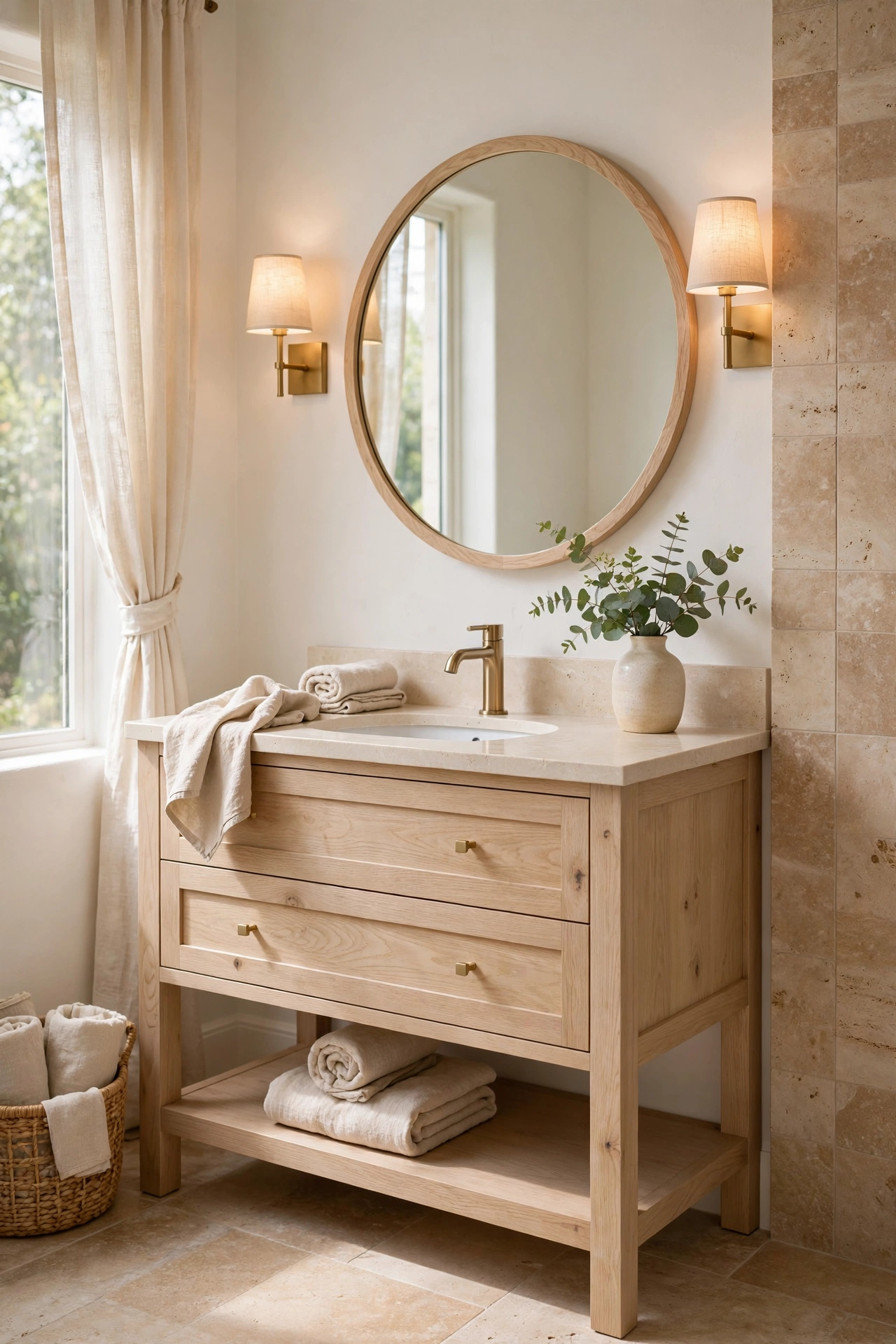
For a true spa atmosphere, let the white oak vanity anchor an all-neutral scheme: warm white walls, a pale oak cabinet, cream stone or quartz, and natural textures like travertine, linen, and teak. The trick is layering close tones rather than matching them — the slight variation between wall, wood, and stone keeps the room from feeling flat. Add life with eucalyptus stems in a stoneware vase, a teak bath mat, and dimmable warm lighting that drops to candlelight levels for evening soaks. Keep hardware minimal and tonal — brushed nickel or champagne bronze rather than high-contrast black — so nothing interrupts the calm. If you love soft neutral palettes, our cream and white bedroom ideas use the same layering principles and translate beautifully to a bath.
22. Backsplash Ledge Shelf Above the Vanity
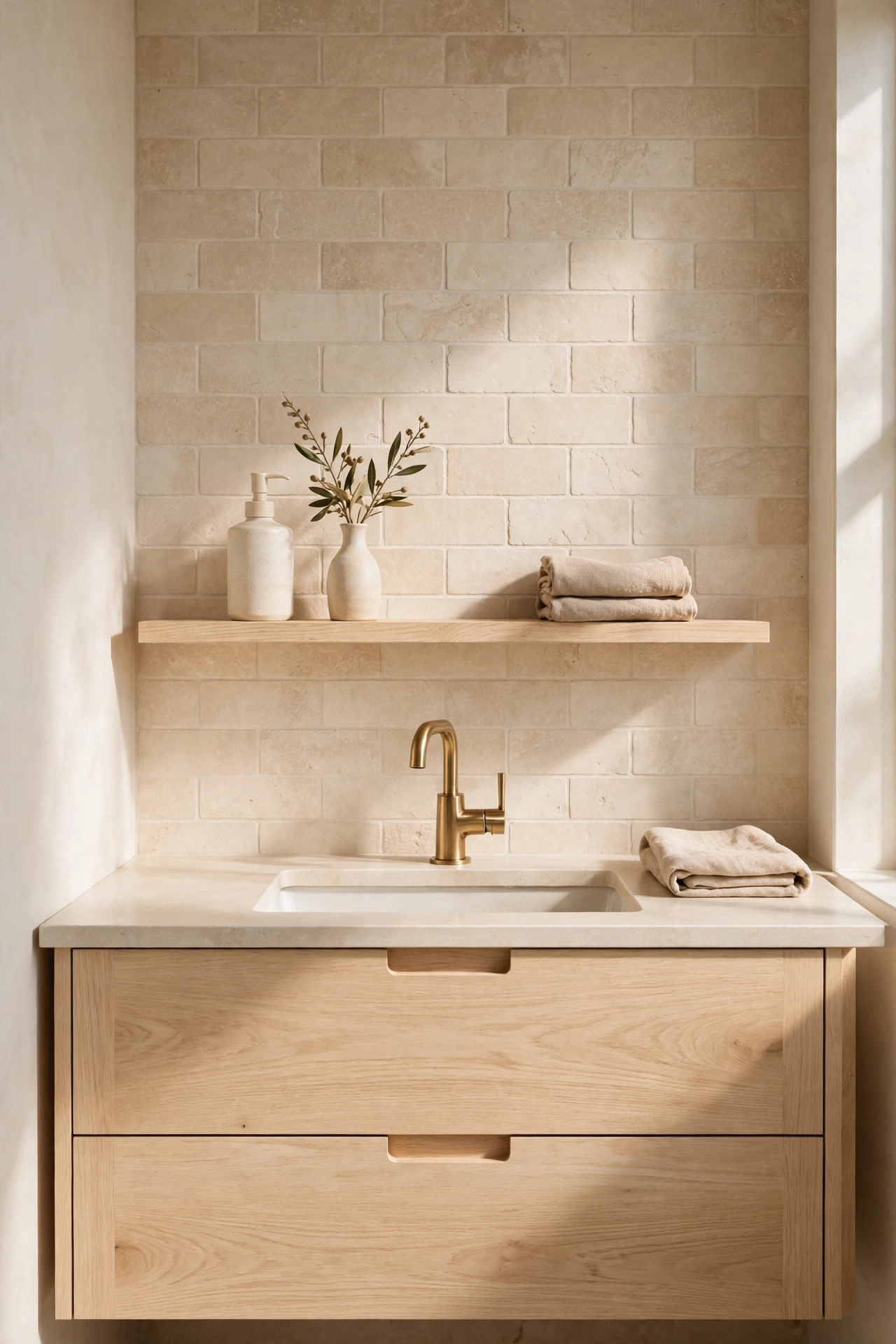
A slim oak ledge shelf mounted on the backsplash above the vanity adds display space without the bulk of a medicine cabinet. Match the ledge to the vanity’s white oak — same species, same finish — so it reads as a floating extension of the cabinet itself. Style it with daily essentials in beautiful vessels: a soap dispenser, a small bud vase, a folded hand towel, and perhaps a candle. The ledge keeps these items off the counter, freeing the stone top for actual use, and it fills the often-awkward gap between counter and mirror with intention. Mount it 8 to 12 inches above the counter so taller bottles fit underneath, and keep the styling edited: a crowded ledge reads as clutter, while three to five objects read as design. In a double vanity, run one long ledge across both sinks for symmetry.
23. Rift-Sawn White Oak for a Modern Linear Grain
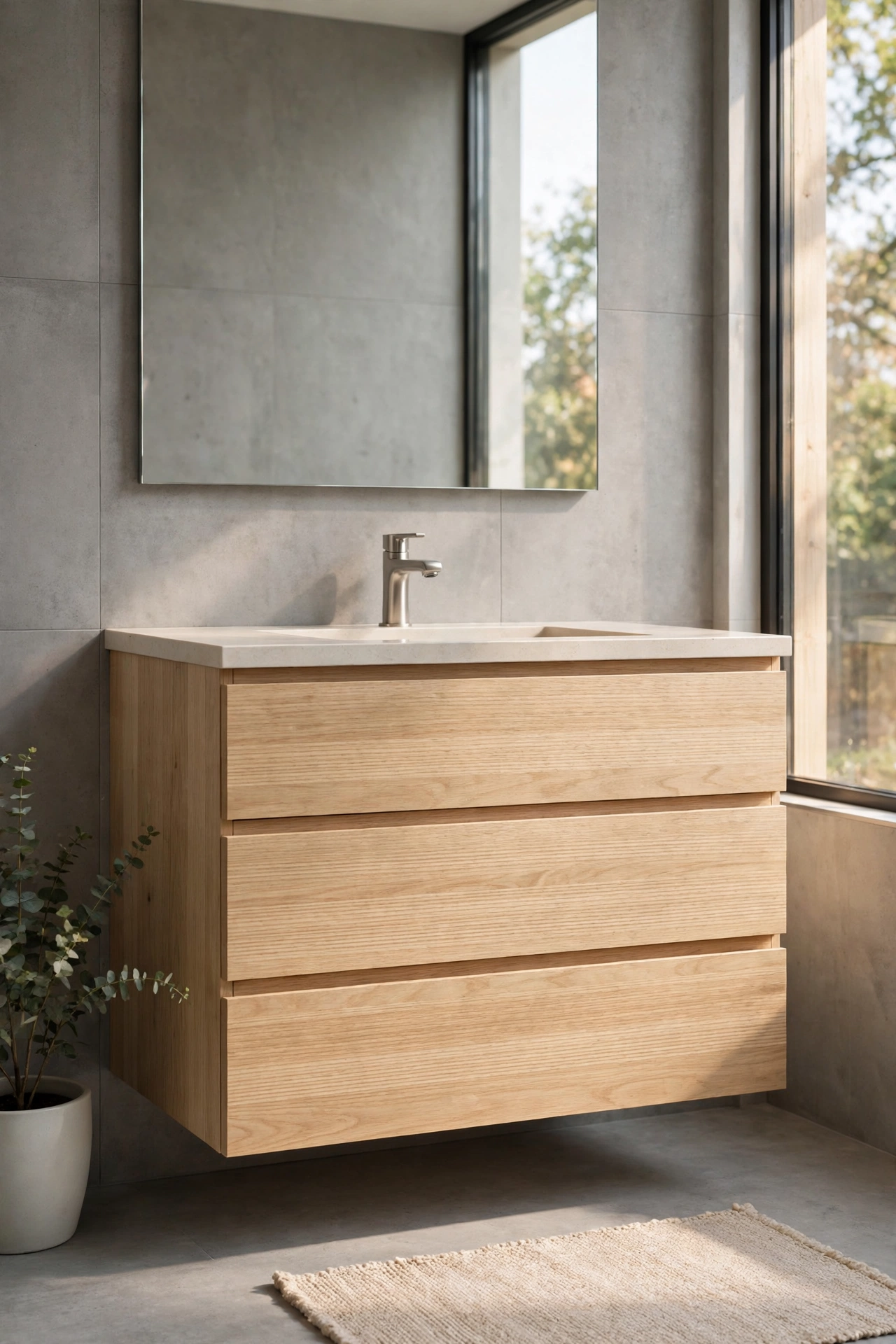
If you love white oak but want it to read unmistakably modern, specify rift-sawn veneer. Rift sawing cuts the log at an angle that produces straight, parallel grain lines with almost no cathedral patterns — the result is a calm, linear surface that feels tailored and contemporary. On a vanity, rift-sawn oak pairs perfectly with slab fronts, waterfall sides, and minimal hardware, letting the wood’s quiet texture carry the design. Book-match the veneer across wide drawer fronts for a mirror-image grain that looks bespoke, and finish it in a matte clear coat that protects without adding shine. The upcharge over plain-sawn oak is modest in the context of a full bath remodel, and the refined result photographs beautifully. Ask your cabinetmaker to show you rift-sawn samples next to plain-sawn ones — the difference is immediately visible.
Frequently Asked Questions
Is white oak a good wood for a bathroom vanity?
Yes. White oak is a dense hardwood with a tight grain structure that resists moisture better than many common cabinet woods. In a bathroom it still needs protection — a quality conversion-varnish, marine-grade polyurethane, or hardwax-oil finish on all surfaces, including end grain and the underside — plus good ventilation in the room. With those basics covered, a white oak vanity stands up to daily bathroom humidity for decades.
How do I keep water from damaging my white oak vanity?
Wipe up standing water promptly, especially around the sink and faucet base, and make sure the finish is intact — water left to sit on worn finish will darken the wood. Run the bath fan during and after showers to keep humidity down, and re-check the silicone seal where the countertop meets the wood every year or two. Avoid harsh cleaners; a damp microfiber cloth with mild soap is all the daily maintenance oak needs.
What countertop looks best with a white oak vanity?
Warm-white quartz is the most forgiving all-rounder: durable, non-porous, and tonally in step with the wood. Marble-look porcelain gives a more luxurious read without marble’s maintenance, and natural stone like honed Carrara or quartzite suits traditional baths. For contrast, concrete-look tops or charcoal-veined quartz make the oak’s warmth pop. Almost any top works — the key is deciding whether you want the palette tonal and calm or high-contrast and graphic.
What hardware finish pairs with white oak?
Brass (brushed or unlacquered) amplifies the wood’s warmth and is the classic choice. Matte black creates striking contrast and a modern edge. Brushed nickel or champagne bronze keep things soft and neutral for spa-like schemes. Whichever you choose, repeat it across the faucet, pulls, and mirror frame for a cohesive look — mixing three different metals is where most vanity designs go wrong.
Should the vanity be floating or floor-standing?
Floating vanities make small bathrooms feel larger and simplify cleaning, but they need solid wall blocking and careful plumbing planning. Floor-standing vanities offer more storage, hide plumbing easily, and suit traditional or furniture-style looks. In a powder room, floating almost always wins; in a family bath where storage matters, a floor-standing or legged oak vanity is the more practical choice.
Conclusion
A white oak bathroom vanity is one of those rare design choices that works in nearly any bathroom — it warms up modern minimalism, grounds rustic schemes, and flatters everything from brass to matte black. Whether you fell for the floating silhouette, the reclaimed character piece, or the quietly luxurious rift-sawn slab fronts, the throughline is the same: natural texture that makes hard bathroom surfaces feel human. Pick the idea that fits your floor plan and your daily routine, invest in a proper moisture-resistant finish, and enjoy a vanity that will look better in ten years than the day it was installed.