
Months Calculator
💡 How to Use This Calculator
This Months Calculator is a straightforward tool designed to help you perform various date-related calculations:
- Add: Input a starting date and specify the number of years, months, weeks, or days you wish to add. Click “Calculate Result” to determine the new date.
- Subtract: Provide a starting date and then enter the years, months, weeks, or days you want to subtract. Click “Calculate Result” to find the resulting past date.
- Duration Between: Enter both a start date and an end date. Click “Calculate Result” to view the precise duration between them, broken down into years, months, and days, along with the total number of days.
To clear all your entries and begin a fresh calculation, simply click the “Reset All” button.
A month calculator or month counter is a simple tool used to calculate the exact number of months between two given dates. If the number of months between two dates is inadequate, the number of days is provided instead.
It's easy to figure out how many months are between two dates if you know how many months are between the dates!
How to Use the Months Calculator
In the Months Calculator, you select whether you want to add, subtract, or calculate the total number of months between two dates then enter the relevant input values and click Calculate. More detailed instructions are available here.
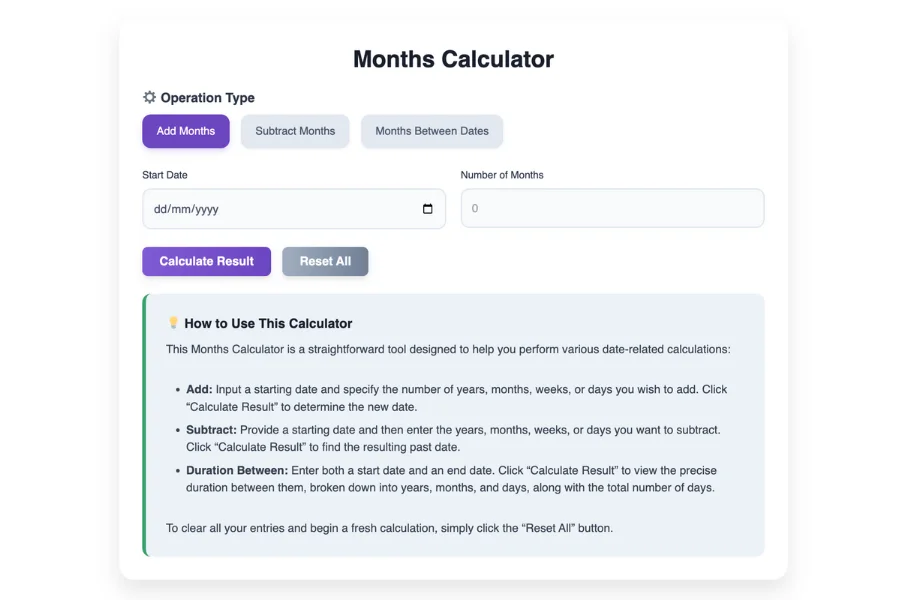
- Step 1: In the uppermost part of the calculator, you will find the Operation Type field set, where you can choose between adding, subtracting, and separating months. The default month between option is selected for this example.
- Step 2: Next, select the type of operation, and fill out the input fields Start Date and End Date. The Start Date marks the beginning of the countdown, and the End Date marks the end.
- Step 3: Click on Calculate to get your results. You can also click on Clear to clear the filled-in input fields.
Adding or subtracting months from a starting date is done by first selecting the operation and then entering the starting date and the number of days.
A calculator for adding and subtracting months from now is available, but this one offers more options for combining months.
The tool is particularly handy for planning events, calculating rent or subscriptions, or simply satisfying your curiosity about the duration between two points in time.
Dive deeper to learn more about the month calculator, its uses in various contexts, and the principles it uses to calculate time differences.
How does a leap year work?
What is a leap year? If you or someone you know has a birthday on February 29th, you should know what it is.
Leap years (also known as intercalary years or leap year) are calendar years with an extra day added to keep the calendar year aligned with the astronomical or seasonal year.
Due to the Earth's orbit around the Sun taking approximately 365 days, 5 hours, 48 minutes, 45 seconds, a calendar containing only whole days will drift over time. An extra day can be added (or intercalated, to use technical terminology) to eliminate the difference. A common year is one without a leap year.
Try the date calculator if you want to know more. 📅
The number of months between two dates can be calculated in several ways
If one does not consider leap year adjustments, then one can be off by a month or more in certain situations. In addition, different months have different days, making it difficult to calculate the number of months between two dates.
The month counter allows you to keep track of the number of days in each month, regardless of whether it has 30 days or 31 days.
You can adjust the count based on the number of days in any given month by using the following table:
| Month | Number of days | Days in a leap year |
| January | 31 | 31 |
| February | 28 | 29 |
| March | 31 | 31 |
| April | 30 | 30 |
| May | 31 | 31 |
| June | 30 | 30 |
| July | 31 | 31 |
| August | 31 | 31 |
| September | 30 | 30 |
| October | 31 | 31 |
| November | 30 | 30 |
| December | 31 | 31 |
It does not matter how many days there are in each month, nor how many leap years there are, when calculating how many months there are between two exact dates. For example, between March 1 and October 1, 2025 there are always seven full months. No matter the leap year, Feb 1 to Jul 31 is always six full months, so no leap-year adjustments are needed to determine how many months between dates.
There can be differences in the month count for a given number of days before or after a given date depending on leap years and the exact months covered. For example, 150 days starting from Jan 1 equals May 31, 2022. This period has exactly 5 months. As a result, if the period is not accompanied by a February or a leap year, there will be no complications. 150 days from Jan 1, 2024 is May 30, 2024, which is just four months. When such a time period occurs, the month count always remains the same.
How many months are left until X?
For example, it may be necessary to check what the date will be in a month's time, or what it will be in five months' time, etc. To do so, add a month to the present date, or to the date of interest. Calculating calendars with months is way simpler than most people think, since the month stays the same in calendar calculations.
By adding four months to the current month, for example, subtract twelve from the resulting number and roll the remaining months into the next year if it is greater than 12. As an example, on October 15 (10/15) you would add 10 + 4 = 14, subtract 12 to get 2. The second month would then be February, so four months later you would have February 15.
Except in cases where the resulting month has fewer days than the current month, or if the current date is on a 31st, and the resulting month only has 30 days. A non-leap or leap year can result in an issue with the 30-th and 29-th of the resulting month, if February is the resulting month. In a month with an irregular number of days, six months from August 30 would logically result in February 30, but since there is no such date, one needs to roll into the next month. In a leap year, if one wants to calculate six months from Aug 30, it would result in Mar 2 or Mar 1 in the following year, depending on whether it is a non-leap year.
How often does a leap year occur?
When is leap year? The month of February has 29 days rather than 28 in leap years. This extra day compensates for the fact that the solar year is slightly longer than 365 days on the Gregorian calendar. Solar years last slightly less than 365.25 days (actually, 365.24219 days).
There are some corrections left to be made. A leap year is one that is exactly divisible by four, except in years that are precisely divisible by 100. The exception is in years that are precisely divisible by 400. There are common years such as 1700, 1800, and 1900, but leap years such as 1600 and 2000.
Based on all of the above, the following conditions must be met to determine whether a year is a leap year, which is also used by this calculator:
The year is in leap years if it is non-divisible by 4, otherwise in common years if it is not divisible by 100, else in leap years if it is not divisible by 400, otherwise it is a leap year.
Calculate your monthly expenses using this calculator
The "Exact time between dates" output would be the monthsary if it shows "X months, 0 days". X would be the number of months since you began your relationship. Whenever the number of days exceeds zero, you will see how many days remain until the specified "End date" occurs, rather than the actual monthary date.
How does a monthsary work?
As the name implies, a monthsary is a kind of anniversary. However, instead of counting the years since a particular event, it counts the months between that event and now. Montharies occur when a certain number of months have elapsed between events, such as one month, three months, ten months, etc. As opposed to an anniversary, a monthsary is celebrated when a specific number of months have passed between events. The first month of a couple's relationship is commemorated each month as a romantic monthary.
Beyond Basic Calculations: Related Concepts 💡
While a months calculator focuses on monthly intervals, understanding broader date and time concepts can further enhance your appreciation for such tools.
Leap Years 🗓️
A leap year, occurring every four years, adds an extra day (February 29th) to the calendar. While a months calculator primarily works with months, its underlying date logic must account for leap years to ensure the accuracy of the final date or duration, especially when calculating across multiple years. This precision is vital for correct calendar calculations.
Calendar Systems 🌍
The calculator operates based on the Gregorian calendar, the most widely used civil calendar today. Different cultures and historical periods have used various calendar systems (e.g., Julian calendar, lunar calendars), each with its own rules for defining months and years. While the calculator doesn't convert between systems, its existence highlights the importance of standardized date calculations.
Other Time Units ⏱️
Beyond months, time can be measured in years, quarters, weeks, days, hours, minutes, and seconds. Many date calculators offer conversions or calculations using these other units. For instance, you might use a days calculator to find the total number of days, or a years calculator to determine age in years. The months calculator specializes in the "month" aspect, but it's part of a larger family of time calculation tools.
Working Days vs. Calendar Days 📊
It's important to distinguish between calendar days (all days, including weekends and holidays) and working days (typically Monday to Friday, excluding holidays). While a standard months calculator typically deals with calendar months, some advanced tools can calculate business days or working months, which is crucial for project management and legal deadlines.
Understanding these related concepts helps in fully appreciating the nuances and potential applications of date calculation tools, including the specialized months calculator.
What is the number of months in X days?
Often, people want to convert a number of days into months. In contracts, agreements, and laws, time may be specified as days since an event, rather than as a fixed date. Based on the above table, it is difficult to give a precise answer to this question because each month has a different duration.
In the average month, there are 30.5 days, so five months are on average 152.5 days. "How many months are 150 days" is a common question without an exact answer. It is possible, however, that 150 days might end up being the same as five months if the 150 day period includes February.
You can also use 180 days, which is approximately six months, and 270 days, which is approximately nine months. Here is a handy table for quick reference. For more precise calculations, use the month calculator above.
| Number of days | Number of months* |
| 30 days | 1 month |
| 60 days | 2 months |
| 90 days | 3 months |
| 120 days | 4 months |
| 150 days | 5 months |
| 180 days | 6 months |
| 270 days | 9 months |
FAQs
Is there a way to find the number of months between two dates?
Calculate how many months separate two dates by:
- Make a note of the earlier and later dates (ED and LD).
- Add the results of these formulas if the dates occur within the same year:
- Month LD - month ED; and
- Days (LD - ED)/30.44.
- The results of these formulas should be added if the dates come from different years:
- LD years - ED years - 1 multiplied by 12;
- 12 - ED month + LD month; and
- Days (LD - ED)/30.44.
What is the shortest month of the year?
There are only 28 days in February, making it the shortest month of the year and the only one that is affected by leap years.
What is the length of a leap year?
There are exactly 12 months in a leap year. The only difference is that the shortest month (February) has an extra day to align our calendar with the solar year.
What is the significance of the name March?
March's name is derived from Martius , the first month of the Roman calendar, which in turn is derived from Mars , the Roman god of war and father of Romulus and Remus.